Angelica pachycarpa Lange.
Angelica
Angelica is a native of Spain and western Portugal, now naturalized in New Zealand, and not found in the wild in North America (though there are other angelicas).
Plants: Forms neat mounds about 3′ (91 cm) around. Sometimes described as a biennial or as a “short-lived perennial,” other sources describe it as perennial. Leaves and stems have a faint odor of licorice.
Leaves: Jade green and glossy. Basal leaves are two- to three-pinnate, on short petioles. Stem leaves are one- to three-pinnate, and almost connected directly to the stem (sessile).
Flowers: Large, tight umbels 4–8″ (10–20 cm) across.
Fruits: Up to ⅜″ (1.2 cm) long are brown with lighter colored wings.
Habitats: Forests, grasslands, and stream sides.
Online References:
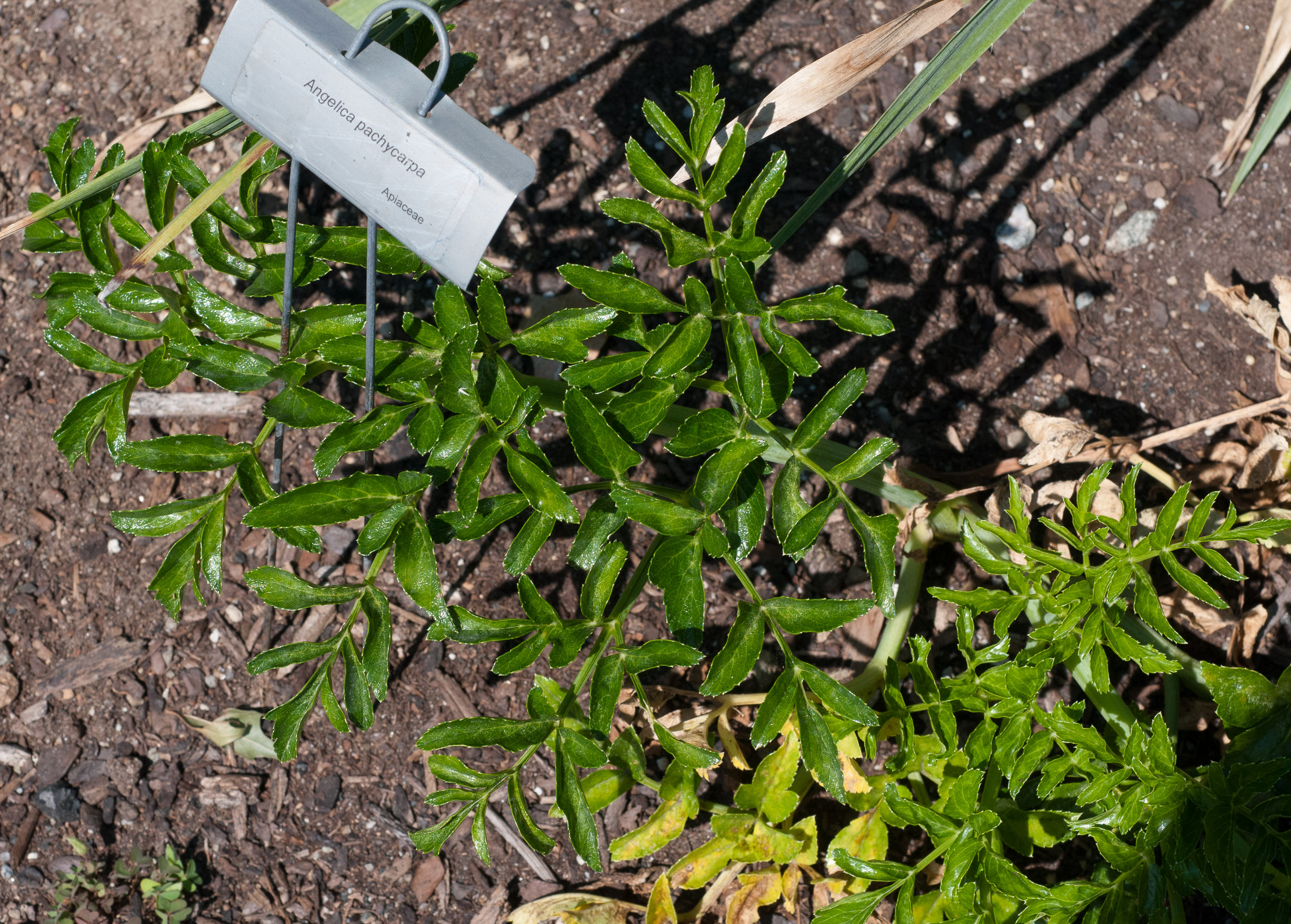
9/7/2010 · New England Botanic Garden at Tower Hill, Boylston, Massachusetts · ≈ 14 × 10″ (36 × 26 cm) 
| Kingdom | Plantae | Plants, but not fungi, lichens, or algae (from Stearn's Botanical Latin) |
| Subkingdom | Tracheobionta | Vascular plants—plants with a “circulatory system” for delivering water and nutrients |
| Division | Magnoliophyta | Flowering plants, also known as angiosperms |
| Class | Magnoliopsida | Dicotyledons—plants with two initial seed leaves |
| Subclass | Asteridae | A large class that encompasses asters |
| Order | Apiales | Includes carrots, celery, parsley, and ivy |
| Family | Apiaceae | Carrot or parsley family, also includes angelica, anise, caraway, celery, chervil, cicely, coriander/cilantro, cumin, dill, fennel, hemlock, lovage, Queen Anne’s Lace, parsnip |
| Genus | Angelica | “Angel-like” |
| Species | pachycarpa | With thick fruits |
Angelica pachycarpa description by Thomas H. Kent, not updated.

© FloraFinder.org. All rights reserved.