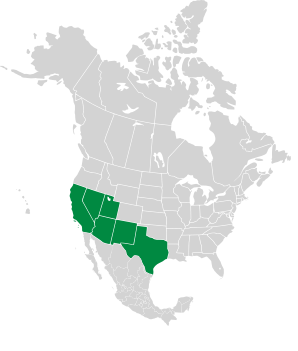
Krameria imparata (J.F. Macbr.) Britton
Krameria parvifolia Benth.
Krameria parvifolia Benth. var. glandulosa (Rose & Painter) J.F. Macbr.
Krameria parvifolia Benth. var. imparata J.F. Macbr.
Krameria erecta Willd. ex Schult.
Pima rhatany, purple heather, littleleaf rhatany
Purple heather is native to the southwestern United States, and northern Mexico—the Mojave, Sonoran and Chihuahuan Deserts and nearby environs—at up to 5000′ (1.5 km) elevation.
Plants: A tangled, heavily branched shrub 1–3′ (30–101 cm) in size. Branches are hairy, gray, woody, and sharp-tipped.
Leaves: Green or gray-green, alternate, sessile, finely hairy, more or less linear, 1/32–½ ⨉ 1/32–1/16″ (0.5–15 ⨉ 0.5–2 mm).
Flowers: About 1″ (2.5 cm) around, with cupped, bright purple-pink sepals that have fine white hairs on the undersides. There are three upper petals, called the flag petals, that are pink-purple. Another pair of lower petals, the glandular petals, are dark purple and thicker, and dotted with dark blisters. There are four upward-curved green stamens in the center. They appear sometime from March to October, depending upon the region and rainfall.
Fruits: Heart-shaped, compressed, and spiny.
Habitats: Dry desert flats and chaparral slopes.
Edibility: Not edible. Unless you happen to be a deer. Purple heather makes up about 10% of the diet of white-tailed deer.
Online References:
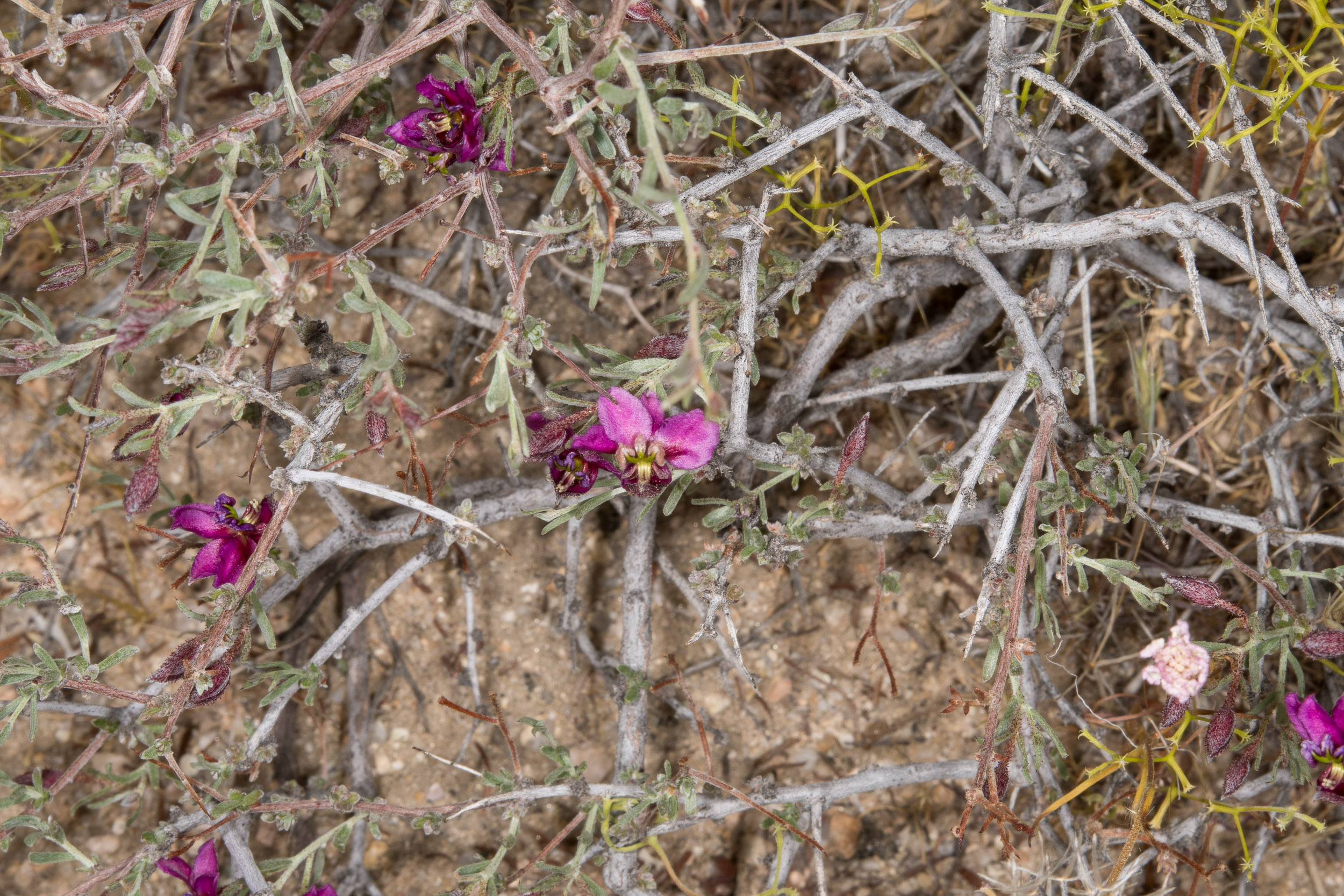
4/30/2018 · Kelbaker Road, Mojave National Preserve, California · ≈ 7 × 4½″ (18 × 12 cm) 
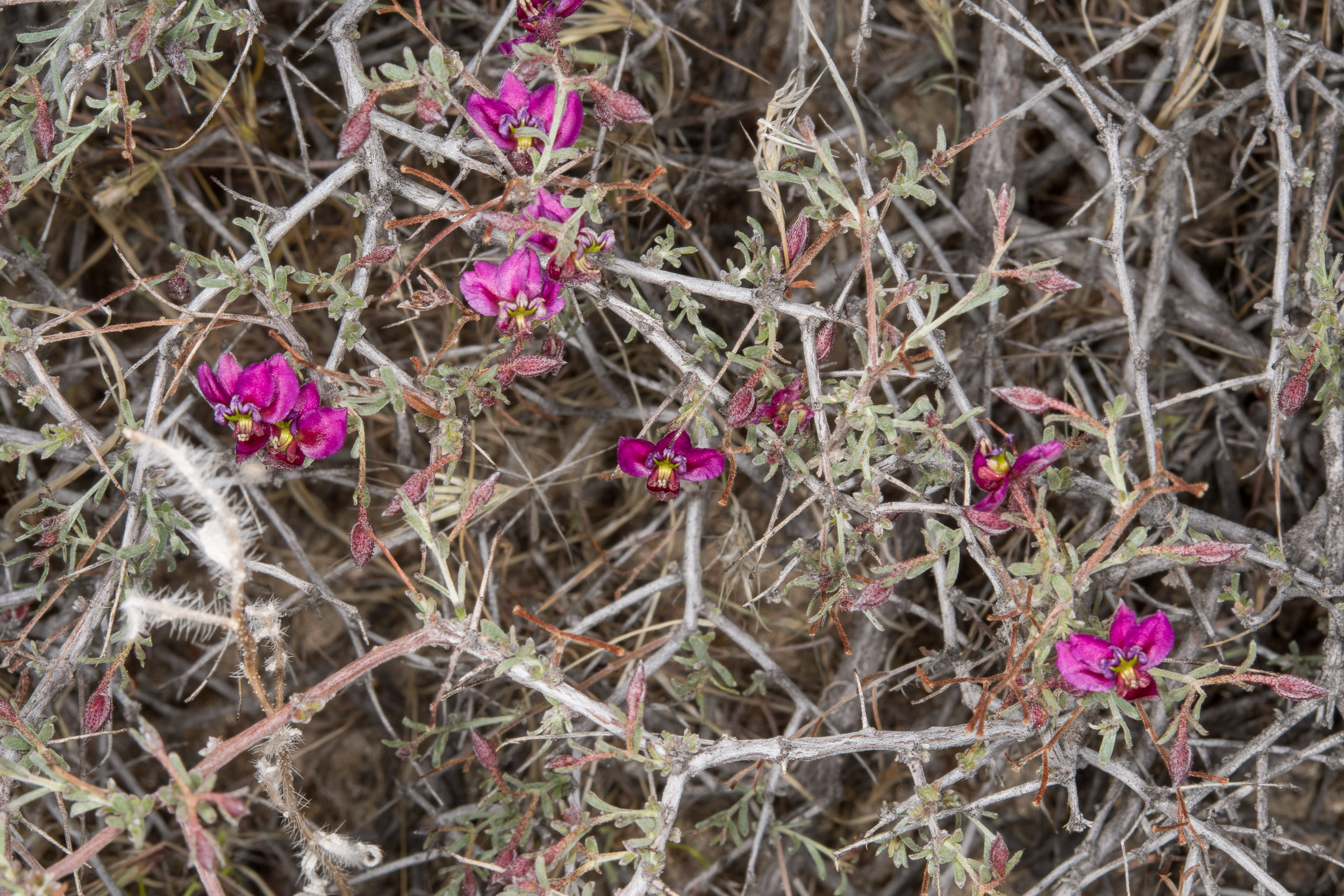
4/30/2018 · Kelbaker Road, Mojave National Preserve, California · ≈ 7 × 4½″ (18 × 12 cm) 
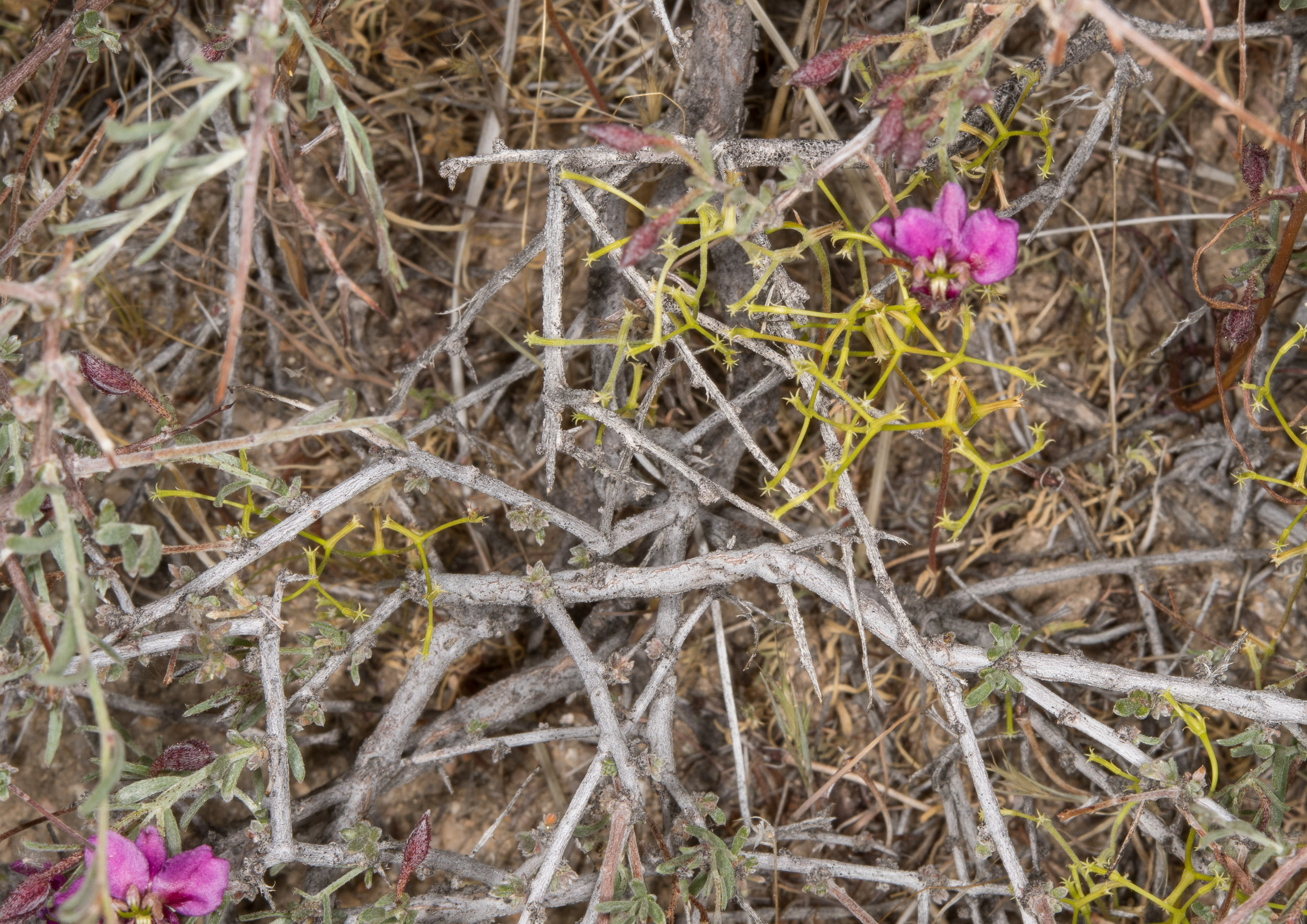
The yellow-green stems with bristly tips are brittle spineflower (Chorizanthe brevicornu). · 4/30/2018 · Kelbaker Road, Mojave National Preserve, California · ≈ 6 × 4″ (14 × 10 cm) 
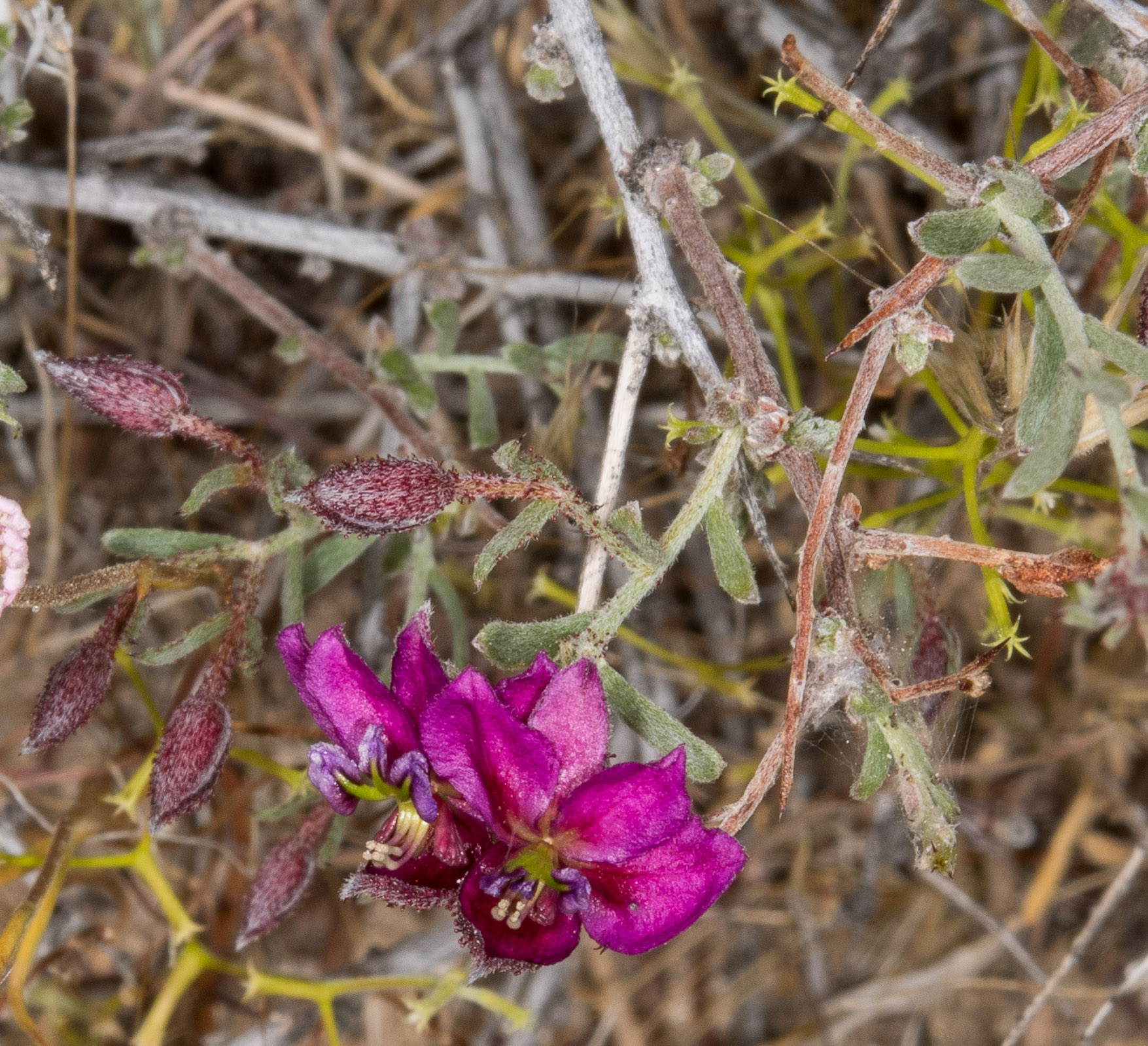
4/30/2018 · Kelbaker Road, Mojave National Preserve, California · ≈ 2 × 1¾″ (5.2 × 4.7 cm) 
| Kingdom | Plantae | Plants, but not fungi, lichens, or algae (from Stearn's Botanical Latin) |
| Subkingdom | Tracheobionta | Vascular plants—plants with a “circulatory system” for delivering water and nutrients |
| Division | Magnoliophyta | Flowering plants, also known as angiosperms |
| Class | Magnoliopsida | Dicotyledons—plants with two initial seed leaves |
| Subclass | Rosidae | Roses, legumes, proteas, dogwoods, hydrangeas, mistletoes, euphorbias, grapes, many more |
| Order | Polygalales | Includes milkwort, krameria, and Barbados cherry families |
| Family | Krameriaceae | Perennial hemiparasitic shrubs, named for the only genus, Krameria |
| Genus | Krameria | After Johann Georg Heinrich Kramer (1684-1744), an Austrian Army physician and botanist, or for his son William Heinrich Kramer (?-1765), physician, naturalist, entomologist and author of Elenchus Vegetabilium and Animalium per Austriam inferiorem Observatorum, a flora and fauna of Lower Austria, which was one of the first works to adopt the binomial nomenclature of Carl von Liné, or for both |
| Species | erecta | Upright |
Krameria erecta description by Thomas H. Kent, not updated.

© FloraFinder.org. All rights reserved.