Acanthophoenix crinita (Bory) H.Wendl.
Barbell palm
Barbell palm is native to La Réunion, Mauritius, and Rodriguez in the Mascarene Islands, where it occurs at elevations of around 1.2 mi (2.0 km). This slow-growing tree is endangered as a result of over-harvesting of its “palm cabbage”—the ends of the edible buds on the tree.
Plants: The sharply restricted wild range of this palm means that you aren’t likely to encounter it, but it is fairly popular as a cultivated plant. This palm has a single trunk. The trunk and underside of the leaves have black spines. Trees are 33–82′ (10–25 m) tall, with trunks 8–12″ (20–30 cm) in diameter. A characteristic swelling at the base of the trunk, the “elephant’s foot,” stores water.
Leaves: Pinnate, with 15-20 leaves in the crown. Sheaths are 3–4′ (90–120 cm) long and 1½′ (45 cm) wide at the base, covered with dense furlike black hairs. Leaves are up to 9½′ (3 m) long, with 70-80 pairs of leaflets in each leaf.
Flowers: Inflorescences are ivory-colored, pendulous, 3–3½′ (1–1.1 m) long, multiply branched in densely arranged triads of flowers. Each triad contains two stalkless staminate flowers flanking one pistillate flower. Staminate flowers are ⅜ ⨉ ⅜″ (1.2 ⨉ 1.2 cm), with 3 sepals and 3 petals, and 9 stamens. Pistillate flowers are roughly globose, ⅛ ⨉ 1/16–⅛″ (4.5 ⨉ 3–4 mm); with similar sepals and petals.
Fruits: Mature fruits are black, with persistent beige or light brown perianth, ellipsoidal, and ½–¾ ⨉ ¼″ (1.5–2 cm ⨉ 8 mm).
Habitats: Foggy and humid locales.
Online References:
Areca crinita Bory
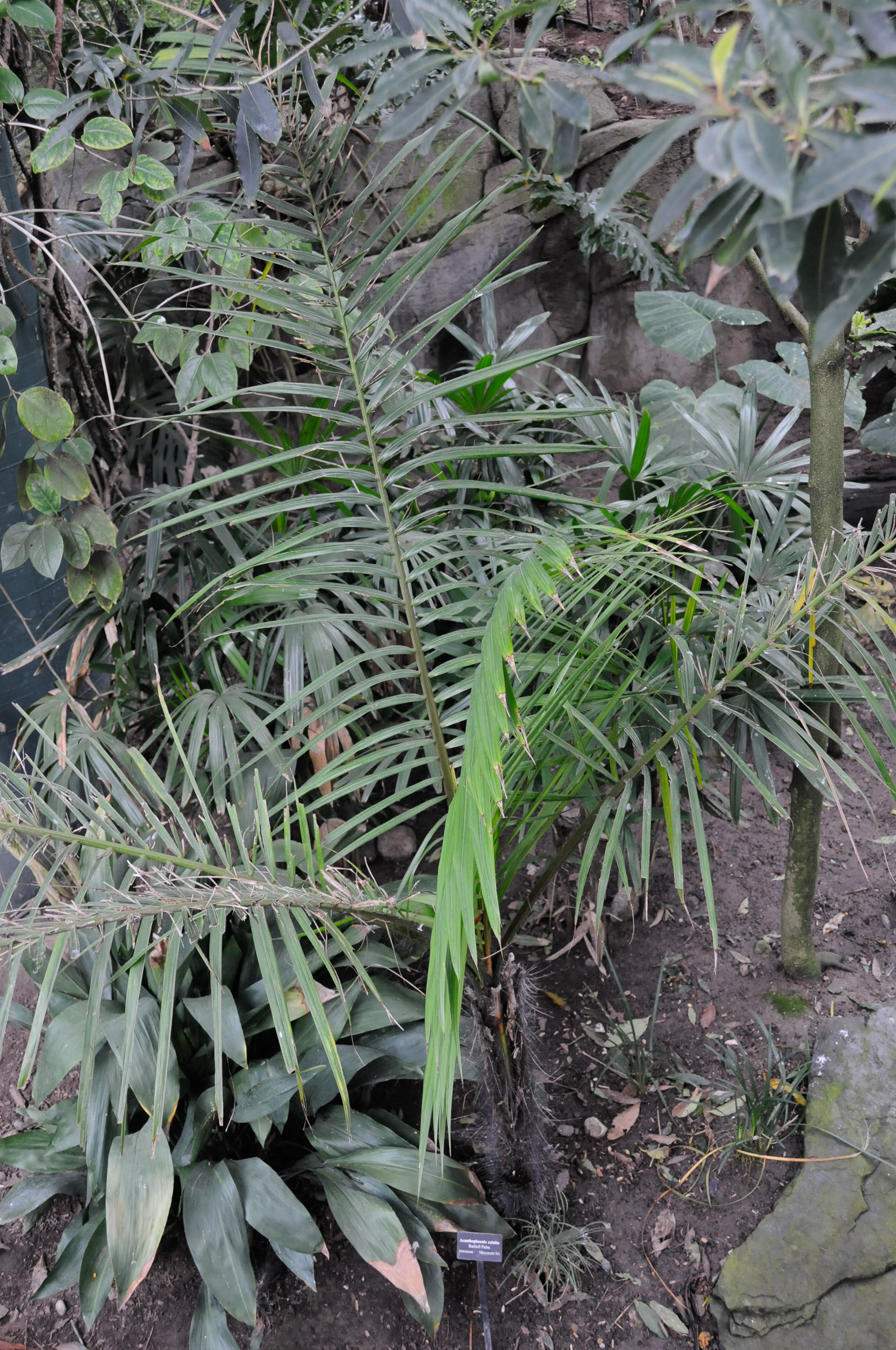
From the Mascarene Islands. · 2/26/2010 · San Diego Zoo, San Diego, California 
| Parents | Unknown | Genus is not in the current taxonomy |
| Genus | Acanthophoenix | Palm-like plants from the Mascarene Islands |
| Species | crinita | Long-haired, having long hair |
Acanthophoenix crinita description by Thomas H. Kent, not updated.

© FloraFinder.org. All rights reserved.