Foraging and Edible Plants Bibliography
Mycophilia: Revelations from the Weird World of Mushrooms
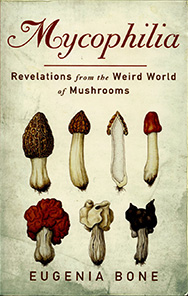
Author(s): Bone, Eugenia
Publisher: Rodale Books, 2011
ISBN: 978-1609619879
Comments: I really enjoyed this book. The author relates her developing infatuation with mycology, the study of fungi. I think she coined the term “mycophilia.” Her writiing is lucid, funny, ireepressibly enthusiastic, and not overly technical. 368 pages.
Tom Brown’s Field Guide: Wild Edible and Medicinal Plants
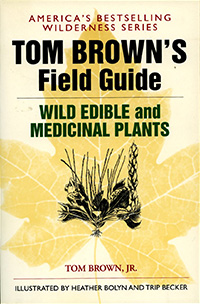
Author(s): Brown Jr, Tom
Publisher: Berkeley Books, 1985
ISBN: 978-0425100639
Comments: Tom Brown presents edibile and medicinal plants, preserving the practical appreciation and reverence held by native Americans who depended upon them for survival. Brown’s writing is approachable and non-technical. About the Author: “Tom Brown, Jr. began to learn hunting and tracking at the age of eight under the tutelage of an Apache elder, medicine man, and scout in Toms River, New Jersey, and is the author of 16 books on nature. He was the technical advisor on The Hunted, a major motion picture starring Tommy Lee Jones and Benecio Del Toro. In 1978, Tom founded the Tracker School in the New Jersey Pine Barrens where he offers more than 25 classes about wilderness survival and environmental protection.” 241 pages.
The Front Yard Forager: Identifying, Collecting, and Cooking the 30 Most Common Urban Weeds
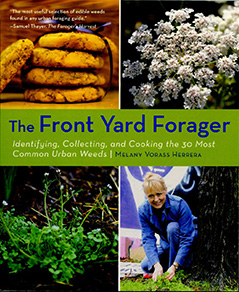
Author(s): Herrera, Melany Vorass
Publisher: Skipstone, 2013
ISBN: 978-1594857478
Comments: Those urban weeds we all ignore because they’re so common? Many are edible and delicious. This guide describes 30 common edible weeds, with information on finding, identifying, and preparing them. The book includes identifying photos, information on when to harvest, lookalikes to avoid, and recipes. 191 pages.
Peterson Field Guides: Edible Wild Plants of Eastern/Central North America
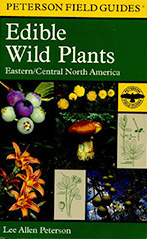
Author(s): Peterson, Lee Allen
Publisher: Houghton Mifflin Company, 1977
ISBN: 978-0395926222
Comments: Like other Peterson field guides, this one presents its subject with facing pages that contain high quality black & white line drawings on one side and text summaries on the other. There is also a section of color plates in the center of the book. Descriptions include brief preparation information, icons indicating the way in which the plants are consumed, and habitat information.
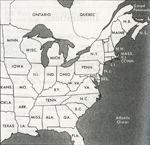
Range:
Wild Plants of Maine: A Useful Guide
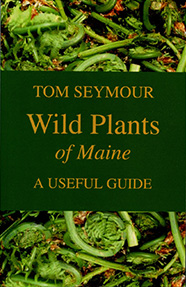
Author(s): Seymour, Tom
Publisher: Just Write Books, 2010
ISBN: 978-1-934949-25-2
Comments: Tom Seymour describes many common edible Maine wild plants. He covers their identification, when to harvest them, and how to prepare them as food. His presentation is practical and readable. 160 pages.
Range: Maine
The Forager’s Harvest: A Guide to Identifying, Harvesting, and Preparing Edible Wild Plants
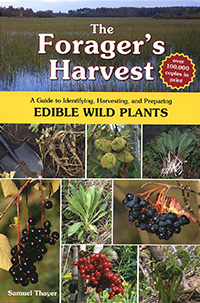
Author(s): Thayer, Samuel
Publisher: Forester’s Harvest Press, 2006
ISBN: 978-0976626602
View at: Barnes and Noble, or Amazon
Comments: In a crowded playing field—foraging books are surprisingly popular—this is a particularly good one. Many field guides describe the species, without enough context for useful foraging, such as precisely when to harvest and how to prepare. The Forager’s Harvest is written more like a book than a guide, with readable descriptions of the species, where and when to harvest them, and their safe preparation. This is a book that will inspire enough confidence to collect and sample nature’s variety. 360 pages.
Range: Range not listed; probably the United States
Backyard Foraging: 65 Familiar Plants You Didn't Know You Could Eat
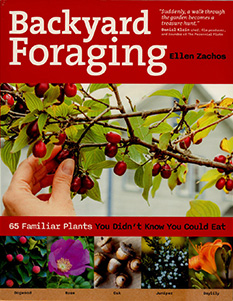
Author(s): Zachos, Ellen
Publisher: Storey Publishing, 2013
View at: Barnes & Noble, or Amazon
Comments: Most of the plants described in this book are so common that, should you glance out your window for a moment, several may be in your field of view. In our own yard, for example, common purslane is duking it out with the vegetables we actually planted. Japanese knotweeed and kousa dogwood are across the street, and oak and sumac are in the back. Photos and descriptions provide the confidence you need to identify these plants safely. Ellen Zachos includes information on safe use and when to harvest, and of course on how to enjoy the plants.
Note: book cover sizes in the list below are shown relative to each other. The list is organized by primary author. Some out-of-copyright books are available free at the supplied links.