Cardamine heterophylla (Nutt.) Alph. Wood
Dentaria heterophylla Nutt.
Cardamine angustata O.E. Schulz
Slender toothwort
Slender toothwort and other members of the bittercress family have recently been moved from the Dentaria genus to Cardamine.
Plants: Slender toothwort is a delicate forest floor plant. It is 8–16″ (20–40 cm) tall, with a stem that is often purple.
Leaves: There are several clusters of three leaves at its base, on a petiole 1–6″ (3–16 cm) long; as well as smaller, narrower 3-part leaves on its stem. Leaves are usually quite deeply divided.
Flowers: Tubular at first, opening into four petals, pale pink or white, in racemes of several flowers.
Fruits: Linear, ⅞–1½ ⨉ 1/32–1/16″ (2.5–4 cm ⨉ 1.5–2.5 mm).
Habitats: Well-drained floodplain forests and mesic to dry-mesic upland forests.
Online References:
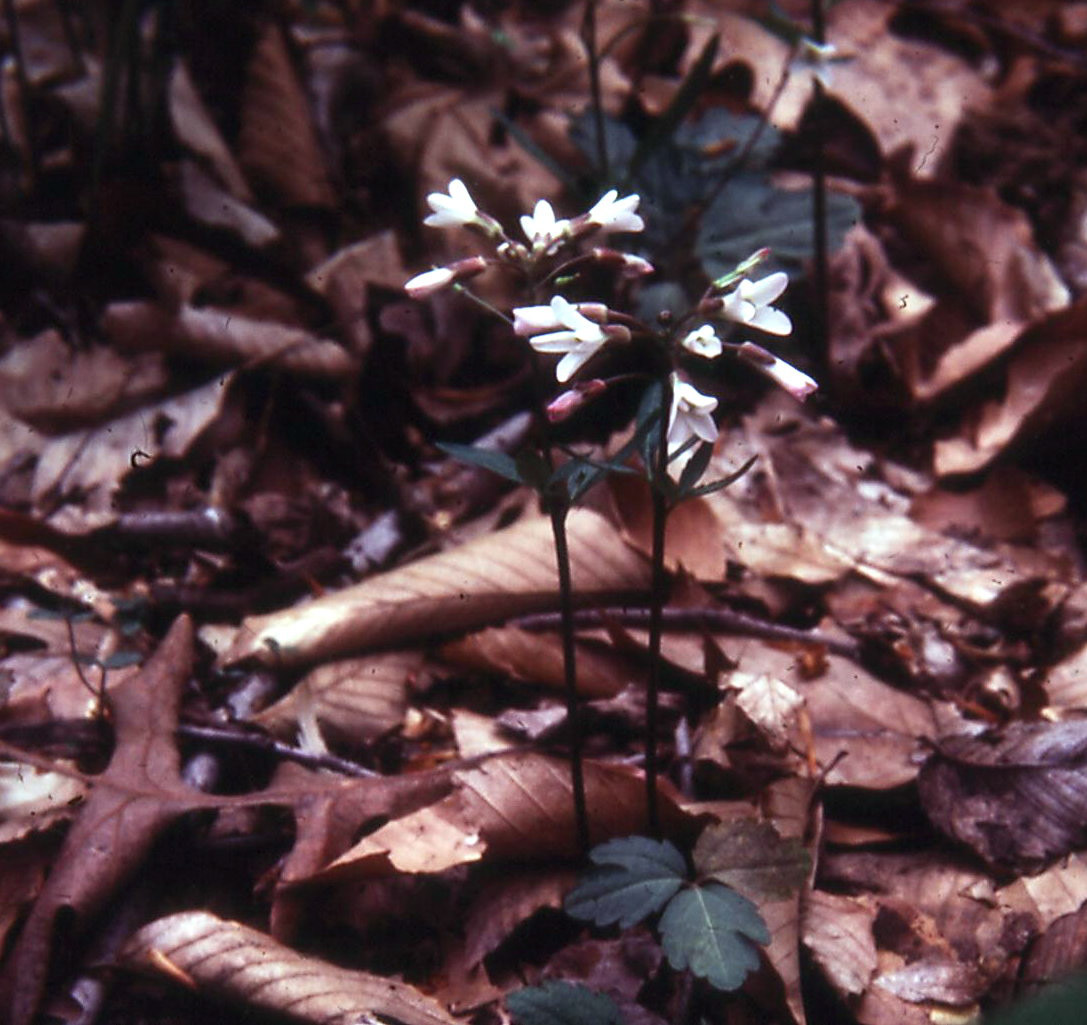
4/15/1979 · Memphis, Tennessee · By Tim Chandler 
| Kingdom | Plantae | Plants, but not fungi, lichens, or algae (from Stearn's Botanical Latin) |
| Subkingdom | Tracheobionta | Vascular plants—plants with a “circulatory system” for delivering water and nutrients |
| Division | Magnoliophyta | Flowering plants, also known as angiosperms |
| Class | Magnoliopsida | Dicotyledons—plants with two initial seed leaves |
| Subclass | Rosidae | Roses, legumes, proteas, dogwoods, hydrangeas, mistletoes, euphorbias, grapes, many more |
| Order | Brassicales | Mustard, cabbage, caper, papaya, nasturtiums, many others; most produce mustard oil |
| Family | Brassicaceae | Mustards, cabbages |
| Genus | Cardamine | Bittercress (also called Dentaria)—from the Greek kardamon, an herb with pungent leaves |
| Species | angustata | From the Latin angustatus, “narrow” or “narrowed.” |
Cardamine angustata description by Thomas H. Kent, not updated.

© FloraFinder.org. All rights reserved.
