Cardamine pratensis L.
Cuckoo flower, lady’s smock, bitter cress
English herbalist John Gerard (1545-1612), in his nearly 1500-page book Herball, or Generall Historie of Plantes, explained the rather curious common name “cuckoo flower” as follows: “These floure for the most part in Aprill and May, when the Cuckow begins to sing her pleasant notes without stammering.” (This was in the Bristish Isles.)
Plants: Plants are 1–2′ (40–60 cm) high.
Leaves: Pinnate, 1¾–4½″ (5–12 cm) long, with leaflets about ⅜″ (1 cm) in size. Leaves are alternate, sometimes toothed.
Flowers: In a spike at the top of the plant, 4–12″ (10–30 cm) in height. Pale pink, white, or pale blue to purple. Each flower is ⅜–¾″ (1–2 cm) in diameter, with four rounded petals and six stamens. Petals are typically notched in the middle.
Fruits: Fruits are slender and straight, ⅝–1¾″ (1.6–5 cm) long.
Habitats: Cuckoo flowers prefer disturbed rich, moist to wet, well-drained soils, in partial or deep shade. Habitats include floodplains, woods, swamps, fields, meadows, shores, grasslands and ditches.
Edibility: Leaves are edible, sometimes used in salads.
Online References:

5/4/2013 · Nashua River Rail Trail, Groton Center, Groton, Massachusetts · ≈ 9 × 6″ (23 × 16 cm) 

5/7/2012 · Nashua River Rail Trail, Groton Center, Groton, Massachusetts · ≈ 9 × 11″ (21 × 27 cm) 
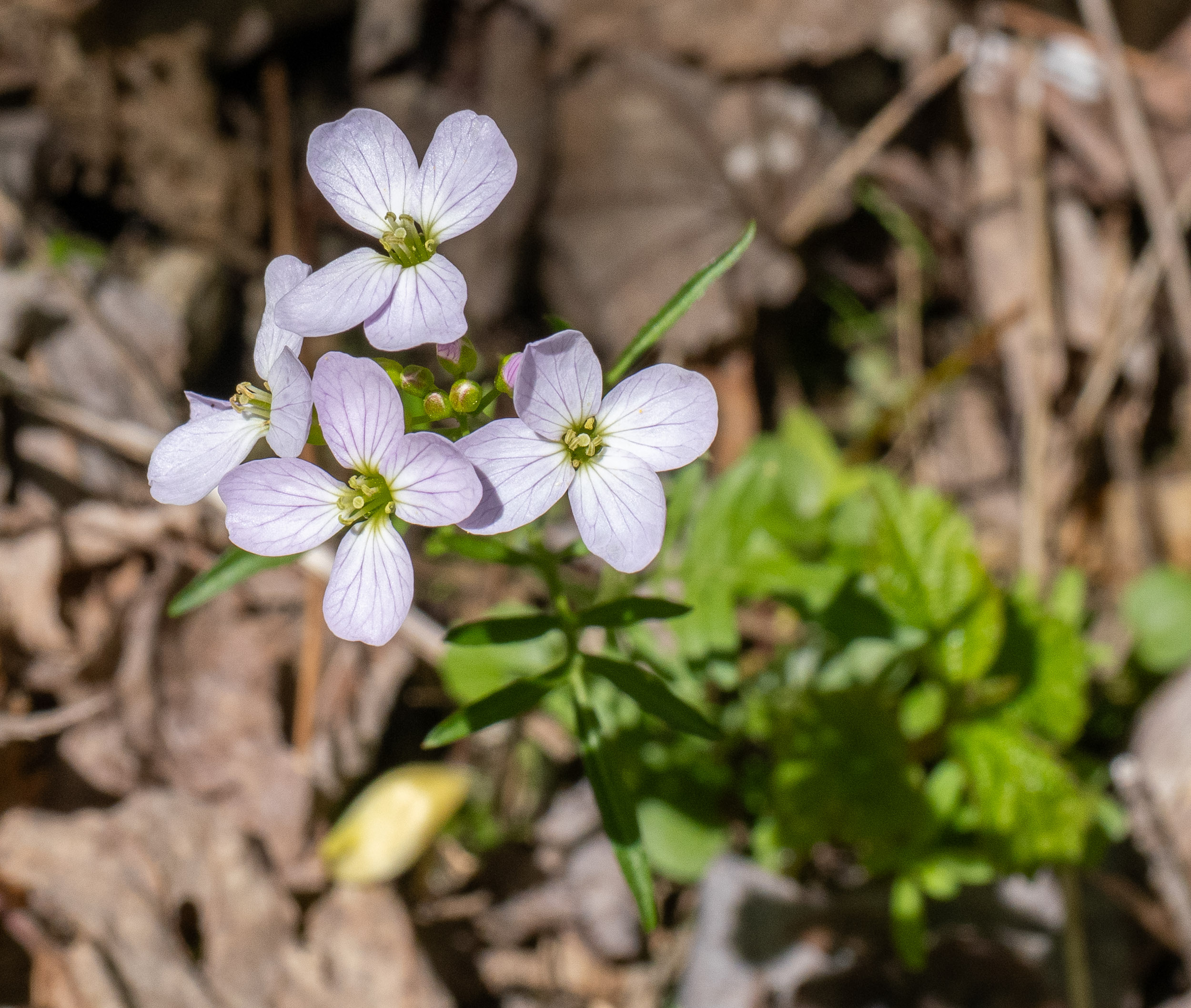
5/16/2025 · Center Point Preserve, Bowdoinham, Maine 

5/4/2017 · Nashua River Rail Trail, Groton Center, Groton, Massachusetts · ≈ 4 × 4″ (10 × 10 cm) 

5/7/2012 · Nashua River Rail Trail, Groton Center, Groton, Massachusetts 

5/18/2021 · Cathance River Nature Preserve, Topsham, Maine · ≈ 2½ × 3″ (7.2 × 7.9 cm) 

5/7/2012 · Nashua River Rail Trail, Groton Center, Groton, Massachusetts · ≈ 6 × 5″ (14 × 13 cm) 

5/18/2021 · Cathance River Nature Preserve, Topsham, Maine · ≈ 3½ × 3½″ (8.8 × 9.3 cm) 

5/4/2013 · Nashua River Rail Trail, Groton Center, Groton, Massachusetts · ≈ 11 × 7″ (26 × 17 cm) 

5/4/2017 · Nashua River Rail Trail, Groton Center, Groton, Massachusetts · ≈ 4½ × 4½″ (11 × 11 cm) 

5/7/2012 · Nashua River Rail Trail, Groton Center, Groton, Massachusetts 
| Kingdom | Plantae | Plants, but not fungi, lichens, or algae (from Stearn's Botanical Latin) |
| Subkingdom | Tracheobionta | Vascular plants—plants with a “circulatory system” for delivering water and nutrients |
| Division | Magnoliophyta | Flowering plants, also known as angiosperms |
| Class | Magnoliopsida | Dicotyledons—plants with two initial seed leaves |
| Subclass | Rosidae | Roses, legumes, proteas, dogwoods, hydrangeas, mistletoes, euphorbias, grapes, many more |
| Order | Brassicales | Mustard, cabbage, caper, papaya, nasturtiums, many others; most produce mustard oil |
| Family | Brassicaceae | Mustards, cabbages |
| Genus | Cardamine | Bittercress (also called Dentaria)—from the Greek kardamon, an herb with pungent leaves |
| Species | pratensis | Growing in meadows |

Cardamine pratensis description by Thomas H. Kent, not updated.

© FloraFinder.org. All rights reserved.