Carex appalachica J. Webber & P.W. Ball
Appalachian sedge
Similar species
Carex appalachica
Carex rosea


|
Carex appalachica J. Webber & P.W. Ball Appalachian sedge Similar species | ||
| You are here Carex appalachica |
Carex rosea |
|
|---|---|---|
| Common Name | |
|
| Plant | Loose tufts up to 2′ (60 cm) tall. | Dense clumps are up to 3′ (90 cm) tall. |
| Leaves | Leaves are so thin that they resemble threads or needles, at a width of ~1/32″ (0.9–1.5 mm). | Smooth, hairless, up to 1′ ⨉ ~1/16″ (40 cm ⨉ 1.8–2.6 mm), with sheaths that tightly wrap around the stem. Young leaves have V-shaped cross sections. |
| Flowers | Inflorescences are ¾–3″ (2–8 cm) long. Each stem has three to six relatively uncrowded spikes, with 2-10 perigynia per spike. | Inflorescences are ¾–2½ ⨉ ⅛–¼″ (2–7 cm ⨉ 5–8 mm), with four to eight spikes per stem. The spikes become more crowded toward the tip of the culm. The terminal spike has staminate (male) flowers at its tip, and pistillate (female) flowers at its base, making them androgynous. Lower spikes may be androgenous or entirely pistillate. There is a bristly bract at the base of each spike. There are 7-14 perigynia per spike, each narrowly oval in shape, and 1/16–⅛ ⨉ 1/32–1/16″ (2.6–4 ⨉ 1.1–1.8 mm) in size. |
| Fruit | The spikes produce achenes 1/32–1/16 ⨉ ~1/32″ (1.4–2 ⨉ 0.8–1.3 mm) in size. | Achenes are ~1/16″ (1.6–2.2 mm) long. |
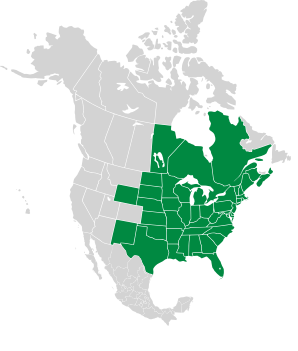
| Range/ Zones |
|
|
| Habitats | Mesic to dry, mixed to deciduous forests. | Stream shores, bottomlands, ponds. |
Carex appalachica description by Thomas H. Kent, not updated.
© FloraFinder.org. All rights reserved.