Carpobrotus edulis (L.) L. Bolus
Ice plant, hottentot fig, highway ice plant, pigface, sour fig
I couldn’t find an explanation for the common name, “ice plants.” It certainly isn’t related to their preferred climate, which is hot and dry. Ice plants are succulents—plants that cope with arid regions by storing water in thick leaves. Ice plants are native to South Africa. They were introduced into North America, where they thrived and are classified as invasive species in many habitats.
Plants: Plants form large, low-growing mats less than 5″ (13 cm) high. Don’t confuse these with Carpobrotus chilensis.
Leaves: 2–4′ (60–130 cm) long, dull green to yellow green, triangular in cross-section, with each edge about ⅜–7/16″ (1–1.2 cm) long.
Flowers: Yellow fading to pale pink and 2½–6″ (6.3–15 cm) in diameter.
Fruits: Multi-chambered, ripening from green to yellow.
Habitats: Coastal sage scrub, disturbed soils.

By Barry Rice at sarracenia.com. 
Edibility: Fully ripe fruit can be made into pickles, chutney, etc. Leaves are edible, used in salads or as a substitute for pickled cucumber, though some don’t like the sticky nature of the interior (like okra).
 |
Similar species. |
Online References:
Mesembryanthemum edule L.

1/5/2026 · South Africa · By Benjamin Winslow 

3/20/2011 · By Benjamin Winslow 
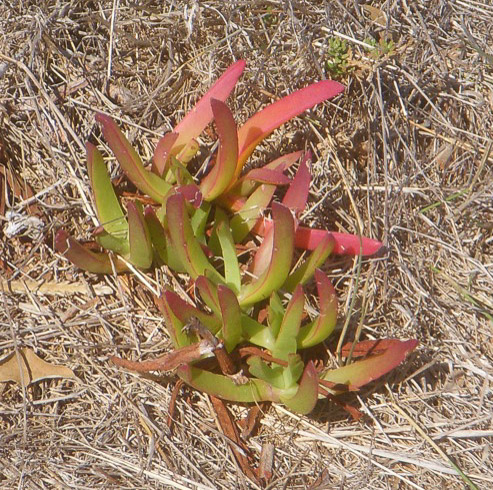
1/5/2026 · Cape of Good Hope, Western Cape, South Africa · By Benjamin Winslow 
| Kingdom | Plantae | Plants, but not fungi, lichens, or algae (from Stearn's Botanical Latin) |
| Subkingdom | Tracheobionta | Vascular plants—plants with a “circulatory system” for delivering water and nutrients |
| Division | Magnoliophyta | Flowering plants, also known as angiosperms |
| Class | Magnoliopsida | Dicotyledons—plants with two initial seed leaves |
| Subclass | Caryophyllidae | Cacti, many other succulents, carnivorous plants, and leadworts |
| Order | Caryophyllales | Includes cacti, carnations, amaranths, ice plants, and many carnivorous plants |
| Family | Aizoaceae | Fig-marigold or ice plant family (previously Mesembryanthemaceae) |
| Genus | Carpobrotus | From Greek carpos, “fruit,” and brotus, “edible” |
| Species | edulis | “Edible”—the fruit is eaten in South Africa |

Carpobrotus edulis description by Thomas H. Kent, not updated.

© FloraFinder.org. All rights reserved.