Ceratozamia hildae G.P.Landry & M.C.Wilson
Bamboo cycad
Natives of Mexico (and now critically endangered there due to habitat loss), bamboo cycads don’t look very much like most other cycads. They come from a deciduous cloud forest around San Luis Potosi and Quiretaro in eastern Mexico. They are not found in the wild in the United States, but they are fairly common in gardens.
Plants: These cycads grow up to 4′ (1.2 m) high. They have a slender trunk about 6″ high ⨉ 4½″ around (15 ⨉ 12 cm).
Leaves: Each crown is up to 3–5′ (1–1.5 m) long, with 20-50 leaflets, on petioles 8–12″ (20–30 cm) long. Each leaflet is dark green and smooth, 2½–9 ⨉ ⅜–1¾″ (7–22 ⨉ 1–5 cm), and lanceolate. This is the only cycad with two sets of leaflets per leaf internode.
Fruits: Male cones are 7–10″ long ⨉ ¾–1″ around (18–25 ⨉ 2–3 cm), and yellowish brown; female cones are 4–6 ⨉ ¾–1″ (10–14 ⨉ 2–3 cm), nearly cylindrical, and olive green. Seeds are ⅝–¾ ⨉ ½″ (1.8–2 ⨉ 1.5 cm), ovoid, and smooth.
Habitats: Deciduous oak woodlands at elevations of 2789–4265′ (850–1300 m).
Edibility:  Poisonous.
Online References:
Www.cycad.org (PDF)
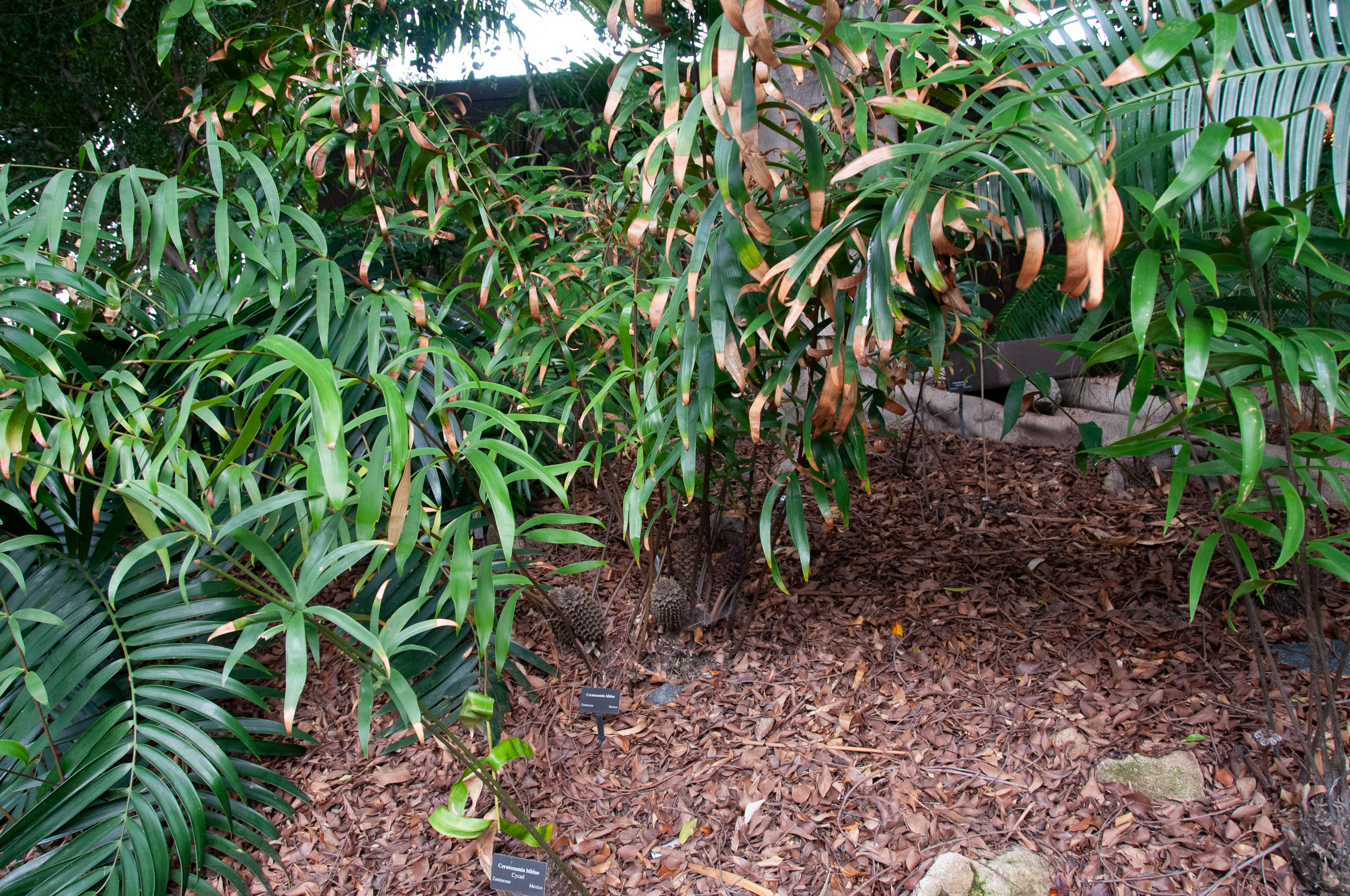
2/26/2010 · San Diego Zoo, San Diego, California · ≈ 6½ × 4′ (2.0 × 1.3 m) 
| Kingdom | Plantae | Plants, but not fungi, lichens, or algae (from Stearn's Botanical Latin) |
| Subkingdom | Tracheobionta | Vascular plants—plants with a “circulatory system” for delivering water and nutrients |
| Division | Cycadophyta | All cycads—primitive palm-like plants |
| Class | Cycadopsida | Cycads |
| Order | Cycadales | Living cycads (most are extinct) |
| Family | Zamiaceae | Cycas that are superficially palm- or fernlike |
| Genus | Ceratozamia | From the Greek ceras, “horn,” which refers to the paired, spreading horny projections on the male and female sporophylls of all species |
| Species | hildae | For Hilda Geissmann, who contributed to nature study in Queensland, Australia |

Ceratozamia hildae description by Thomas H. Kent, not updated.

© FloraFinder.org. All rights reserved.