Crassula perfoliata L. var. minor (Haw.) G.D. Rowley
Propellor plant, propeller plant
Propellor plants are natives of southern South Africa, not found in the wild in North America. The common name refers to the leaves, which are shaped like the blades of a propellor.
Plants: About 1′ (30 cm) tall (not counting the flower stalk).
Leaves: Succulent (thickened to store water), sickle-shaped, grayish-green, up to 3½ ⨉ 1″ (9 ⨉ 2.8 cm) in size. They are often spotted or edged with red, and are edged with very small teeth.
Flowers: On a stalk about 1½′ (50 cm) in height, branching into a rounded or flat-topped flowerhead. Flowers range from bright red to nearly white, described by one source as a “bright red broccoli cluster.” Individual flowers are tubular, and up to ¼″ (7 mm) long.
Fruits: Seeds are very small.
Habitats: North-, east- and west-facing cliffs along dry river valleys.

Crassula perfoliata var. minor in flower. By Groogle. 3/18/2010. 
Online References:
Crassula falcata Wendl.
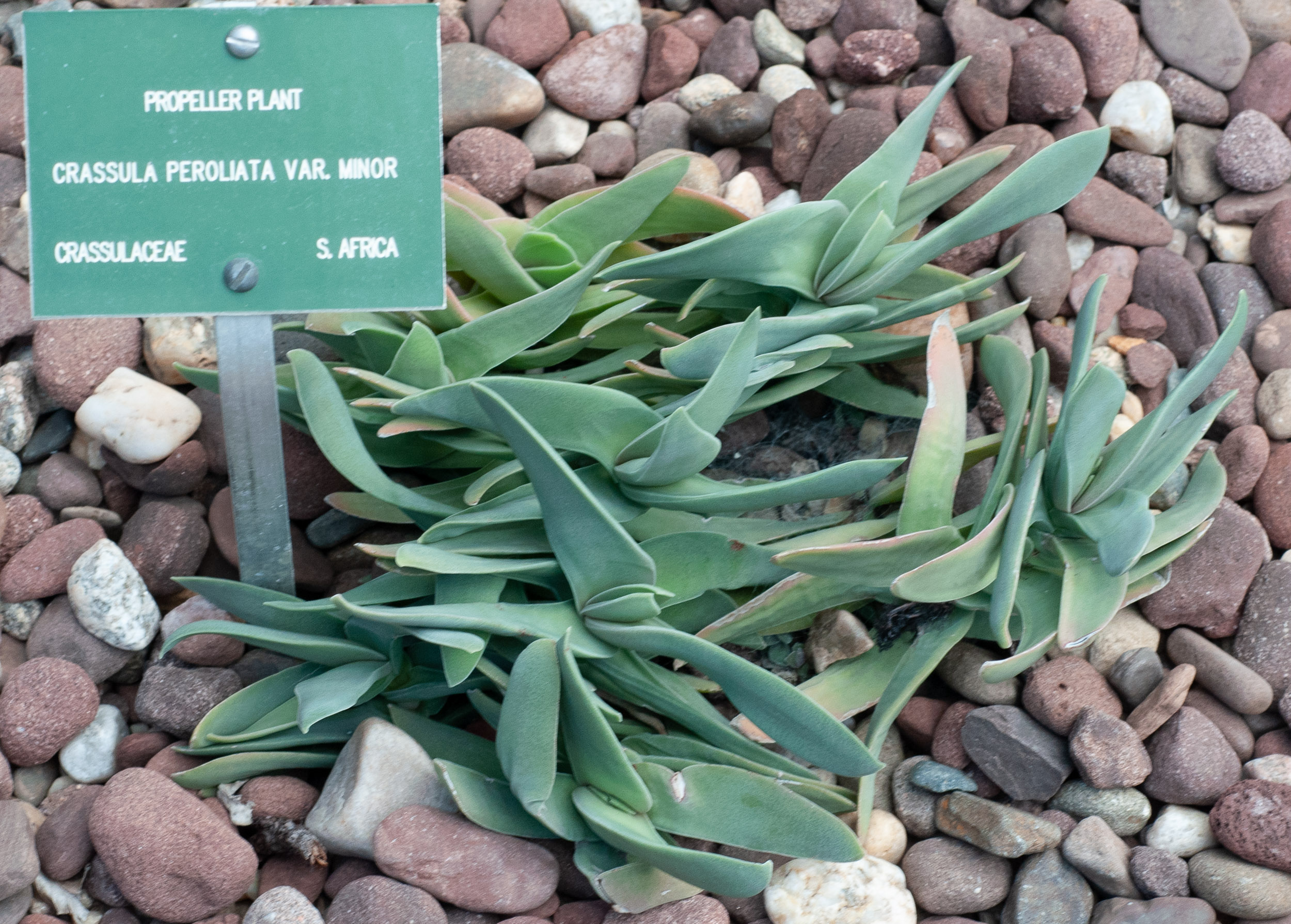
4/6/2011 · Howard Peters Rawlings Conservatory & Botanic Gardens, Druid Hill Park, Baltimore, Maryland · ≈ 14 × 10″ (35 × 25 cm) 
| Kingdom | Plantae | Plants, but not fungi, lichens, or algae (from Stearn's Botanical Latin) |
| Subkingdom | Tracheobionta | Vascular plants—plants with a “circulatory system” for delivering water and nutrients |
| Division | Magnoliophyta | Flowering plants, also known as angiosperms |
| Class | Magnoliopsida | Dicotyledons—plants with two initial seed leaves |
| Subclass | Rosidae | Roses, legumes, proteas, dogwoods, hydrangeas, mistletoes, euphorbias, grapes, many more |
| Order | Rosales | Rose family and eight others |
| Family | Crassulaceae | Succulents that store water in leaves |
| Genus | Crassula | From the Latin crassus, “thick,” referring to the fleshy leaves |
| Species | perfoliata | Refers to the stem which ‘perforates’ the stem |
| var. | minor | Smaller, lesser |

Crassula perfoliata var. minor description by Thomas H. Kent, not updated.

© FloraFinder.org. All rights reserved.