|
Erigeron filifolius (Hook.) Nutt.
Threadleaf daisy, threadleaf fleabane
Similar species
|
| |
Erigeron annuus |
You are here
Erigeron filifolius |
Erigeron philadelphicus |
| Common Name |

daisy fleabane |

threadleaf daisy |

common fleabane |
| Plant |
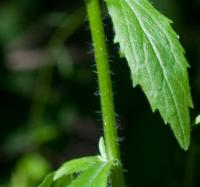 
Up to 5′ (1.5 m) high. Stems have white hairs that grow outward from the stem. |
This perennial daisy’s common name refers to its extremely narrow leaves and nearly bare stems. Plants are 8–40″ (20–101 cm) in height. Stems have dense stiff white hairs. |
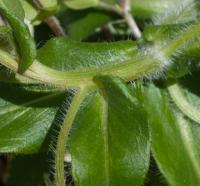
Up to 3′ (1 m) high, with ribbed stems covered with soft white hairs. The hairs grow outward from the stem, rather than lying against it as with some species. |
| Leaves |
Leaves branch alternately from one side of the other, rather than from both sides at once. Upper leaves are narrow and pointed at the ends, with coarse teeth or sometimes no teeth. Leaves near the base of the plant are more egg-shaped, and coarsely toothed or cleft. Leaves are 2–6″ (5–15 cm) long. |
Long, up to 3″ (8 cm), but thin, often threadlike. |
A basal rosette of leaves consists of a spatula-shaped leaves up to 4 ⨉ 1″ (10 ⨉ 3 cm). The leaves have coarse serrations and may be rounded or pointed at the tip. They may be lance-shaped, but show a wide range of shapes. Leaves higher on the stem usually clasp the stem. |
| Flowers |
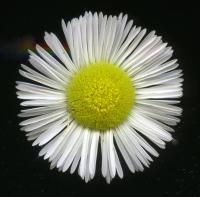
White or light pink to pale lavender, about ½″ (1.3 cm) across, with 40-100 tiny ray florets and yellow centers. This plant flowers abundantly. |
Each stem has a single flower., but stems may be multiply branched, producing flat-topped clusters of ten. Each flower has 15-125 white, blue, pink, or lavendar ray florets, and a yellow center with manby disc florets. Flowers appear from May to July. |
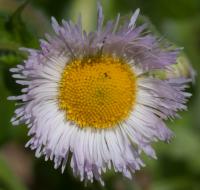
Pale pink, sometimes white, up to ½–¾″ (1.3–1.9 cm) around, with 100-300 petals (more than any other fleabane) and a yellow central disk. The petals are so fine that they often look a bit disheveled, like windblown hair. They flower from April to June. |
| Fruit |
Fruit is a small nondescript seed head, the fine seed is less than 1 millimeter long, brown and nearly plumeless. |
Cypselae are 1/32–1/16″ (1.4–1.8 mm) in size, with a pappus of 20-30 simple hairs. |
Achenes (seeds) have tiny parachutes (pappi), like those of dandelions |
| Range/ Zones |

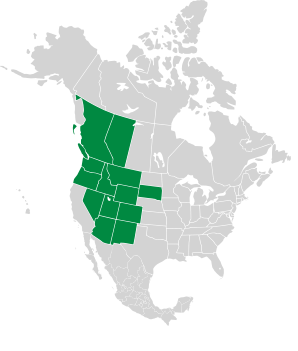
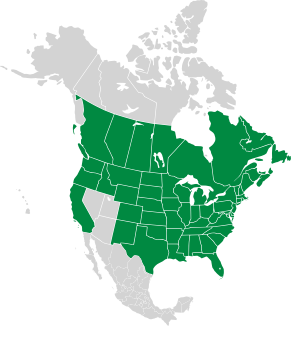
USDA Zones: 3a-8a |
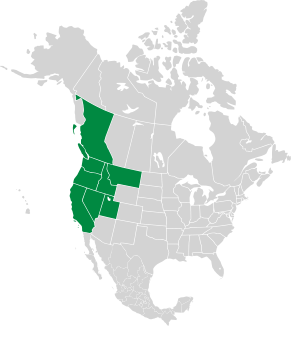
|
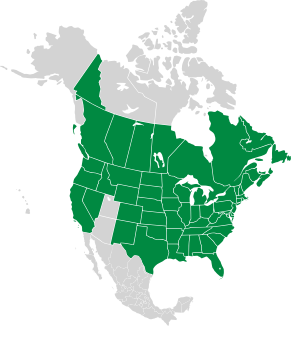
USDA Zones: 2-7 |
| Habitats |
Moist or semi-moist disturbed areas, pastures, abandoned fields, roadsides. |
In grassy or open sites, sagebrush plains, or dry slopes; on rocky, lava, or sandy soils; at elevations of 1312–7874′ (400–2400 m). |
Moist soils at the edges of fresh bodies of water, waste areas, fields, roadsides. |
| Plant |
Perennial plants are 6–40″ (15–101 cm) tall, with an average of 15 fleshy or woody and hairy stems per plant. |
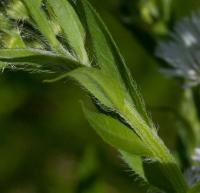
These plants have an erect stem that has many fine white hairs, and are 1–3′ (30–91 cm) tall. The hairs are antrorse strigose, botanist talk for “lying down against the stem, in the upward direction.” |
| Leaves |
Stem and basal leaves are oblanceolate, spatulate, elliptic, or oval. They clasp the stems, or nearly so, and are 1–6 ⨉ ⅛–¾″ (2.5–15 cm ⨉ 5–20 mm), becoming smaller higher on the stems. |
Mostly narrow, attached directly to the stem but not clasping (wrapped around it). Most leaves lack teeth. Lower leaves are fatter in the center. |
| Flowers |
Each stem produces 2-20 flower heads, and each flower head has 75-150 flowers. Each composite flower has a central disc comprised of disc florets, and lavendar, blue, pink or rarely white ray florets. Flowers appear from June to October. |
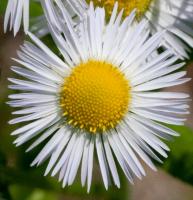
A loose, spindly array of branching stems can support as many as 200 flowers. Flowers are white, about ⅛″ (5 mm) in diameter, with 40-100 ray florets and a central yellow disk with numerous disc florets. They flower from May to September. |
| Fruit |
Two- to four-nerved, oblong and flattened cypselae up to 1/16″ (1.8 mm) long. Fruits are hairy with two, tan, bristly, pappi, the inner of which have 20 to 30 bristles. |
Light brown achenes about 1/32″ (1 mm) long have small tufts of hair, and are distributed in part by wind. |
| Habitats |
Common in upper elevation meadows, sagebrush communities, quaking aspen woodlands, and coniferous forests, in wet and dry habitats, at elevations of 4500–12500′ (1.4–3.8 km) (lower elevations in cooler climes). |
Dry prairies, well-lit woods and fields, disturbed ground, roadsides. |
© FloraFinder.org. All rights reserved.