Euphorbia flanaganii
Medusa’s head, Transkei Medusa’s head, Jellyfish Head Euphorbia, Medusahoved, Green Crown
I’ve always maintained that Euphorbia is a weird genus, since the species take such highly variable forms and the flowers are so odd. It also qualifies as having not one, but two species named after Medusa, the mythical Greek goddess with snakes for hair. This species, Transkei Medusa’s head, is native to the Arabian Peninsula, the Canary Islands, Madagascar, and South Africa. It is not found in North America, though it is cultivated as a house plant.
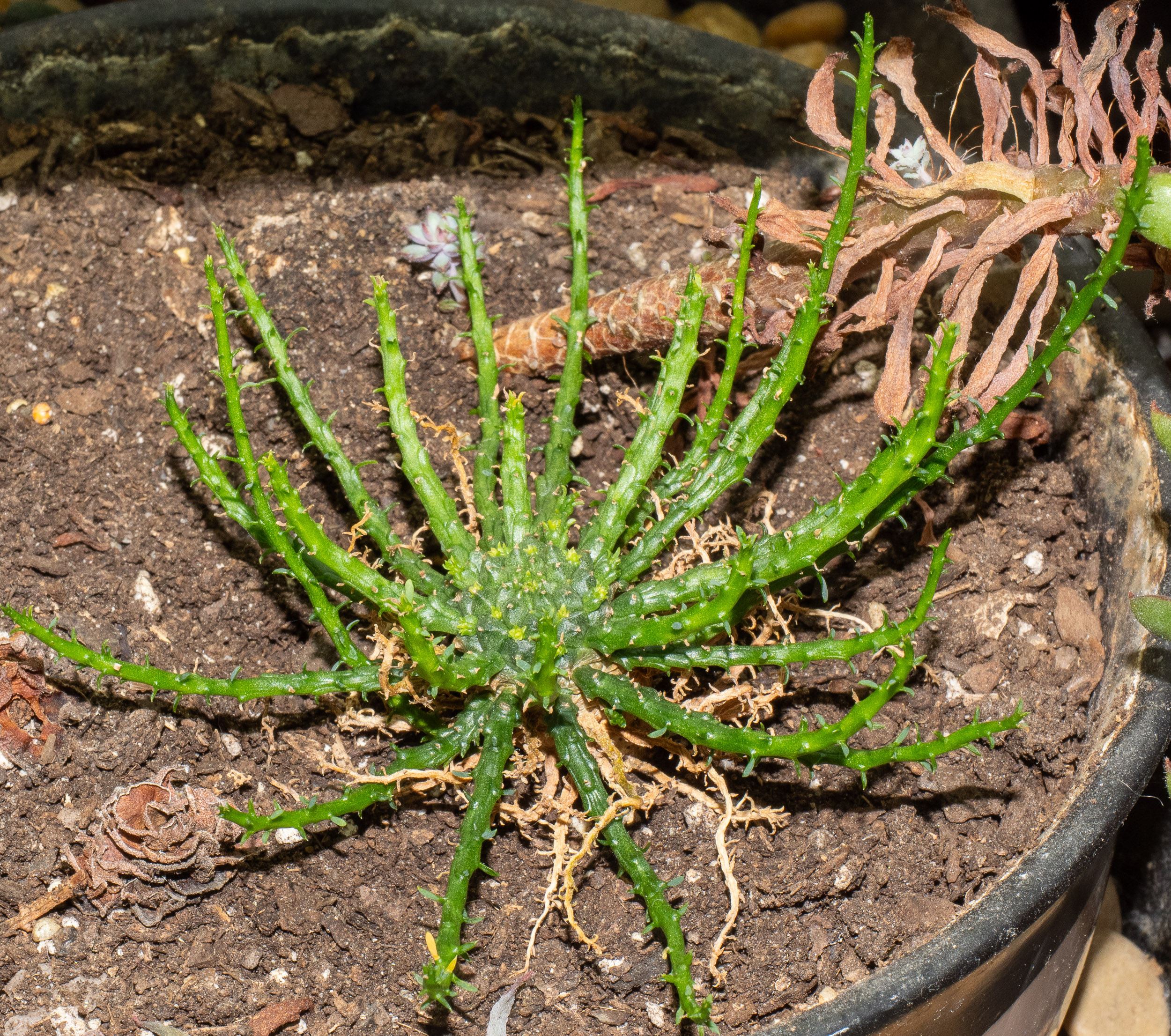
Plants: Emerging from a swollen underground stem, or caudex, snakelike branches with thornlike leaves spread from a central point, lying on the ground. Plants can reach up to 1′ (40 cm) in diameter.
Leaves: Linear leaves are up to ⅜″ long ⨉ 1/32″ wide (1 cm ⨉ 1 mm).
Flowers: Clusters of yellow cyathia appear during the summer. Petal-like bracts are ⅛″ (6 mm) in size.
Fruits: Dehiscent capsules contain seeds.
Habitats: Localized occurrences in sandy grasslands.
Edibility: Poisonous  Toxic if ingested. The sap
can cause a contact dermatitis.
 |
Two Euphorbia Medusas |
Online References:

12/27/2024 · Heather and Katie's, Holbrook, Massachusetts 
12/3/2023 · John Kent’s, Selkirk, New York 

12/27/2024 · Heather and Katie's, Holbrook, Massachusetts 
| Kingdom | Plantae | Plants, but not fungi, lichens, or algae (from Stearn's Botanical Latin) |
| Subkingdom | Tracheobionta | Vascular plants—plants with a “circulatory system” for delivering water and nutrients |
| Division | Magnoliophyta | Flowering plants, also known as angiosperms |
| Class | Magnoliopsida | Dicotyledons—plants with two initial seed leaves |
| Subclass | Rosidae | Roses, legumes, proteas, dogwoods, hydrangeas, mistletoes, euphorbias, grapes, many more |
| Order | Malpighiales | A broad group encompassing 16,000 species |
| Family | Euphorbiaceae | Euphorbia or spurge family |
| Genus | Euphorbia | An extremely diverse-looking genus of mostly tropical and subtropical succulent plants. For Euphorbus, corpulent Greek physician of Juba II, King of Mauretania. Literally, “euphorbia” means “well-fed” |
| Species | flanaganii | For Henry George Flanagan (1861-1919), South African-born plant collector |

Euphorbia flanaganii description by Thomas H. Kent, not updated.

© FloraFinder.org. All rights reserved.