Bisnaga glaucescens (A. P. de Candolle) Orcutt 1926
Echinocactus pfeifferi Zuccarini 1837
Ferocactus pfeifferi (Zuccarini) Backeberg 1961
Ferocactus glaucescens (A. P. de Candolle) Britton & Rose 1922
Blue barrel
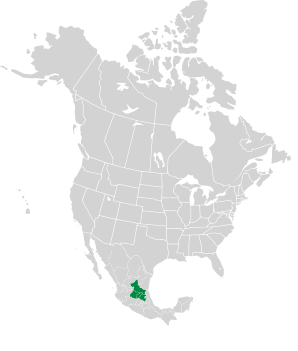
Ferocactus glaucescens means roughly “fierce bluish cactus”—a pretty good description, since the body is bluish green (”glaucous”) and the spines are not to be trifled with. These cacti are found only in Hidalgo, Mexico.
Plants: Plants are distinctly bluish in color, ball-shaped, usually with flattened tops, found singly or in multiply branched groups. They are up to 1½′ (55 cm) high and 1½′ (50 cm) around, with 11-17 ribs. Spines are in groups of 6-7, to 1¼″ (3.5 cm) long.
Flowers: Yellow, bell- or funnel-shaped flowers are up to 1¾″ (4.5 cm) long.
Fruits: Whitish or yellowish fruits are up to ⅞″ (2.5 cm) long.
Habitats: Deciduous dry forests and dry shrubland habitats on limestone hills and boulders., at elevation of 1804–7546′ (550–2300 m).
Online References:
References:

4/6/2011 · Howard Peters Rawlings Conservatory & Botanic Gardens, Druid Hill Park, Baltimore, Maryland · ≈ 10 × 11″ (26 × 27 cm) 
| Kingdom | Plantae | Plants, but not fungi, lichens, or algae (from Stearn's Botanical Latin) |
| Subkingdom | Tracheobionta | Vascular plants—plants with a “circulatory system” for delivering water and nutrients |
| Division | Magnoliophyta | Flowering plants, also known as angiosperms |
| Class | Magnoliopsida | Dicotyledons—plants with two initial seed leaves |
| Subclass | Caryophyllidae | Cacti, many other succulents, carnivorous plants, and leadworts |
| Order | Caryophyllales | Includes cacti, carnations, amaranths, ice plants, and many carnivorous plants |
| Family | Cactaceae | Succulent (water-storing) plants, often spiny |
| Genus | Ferocactus | From the Latin ferus, “fierce,” and cactus, referring to its heavy spines |
| Species | glaucescens | Somewhat glaucous |
Ferocactus glaucescens description by Thomas H. Kent, not updated.

© FloraFinder.org. All rights reserved.