Helianthus tuberosus L. var. subcanescens A. Gray
Helianthus tuberosus L.
Jerusalem artichoke, sunroot, sunchoke, earth apple, topinambour
Jerusalem artichokes aren’t from Jerusalem, they’re from eastern North America. They aren’t artichokes either—they are members of the sunflower family. The rather odd name is probably a mangled version of the Italian girosole articiocco, or “sunflower artichoke,” a name which makes more sense, since the roots’ taste is often likened to that of artichokes.
Plants: 5–9½′ (1.5–3 m) tall, with hairy stems.
Leaves: On the lower part of the stem, leaves are opposite, but they are alternate higher up. Leaves are up to 12 ⨉ 8″ (30 ⨉ 20 cm) wide near the base of the plant, becoming narrower (more lanceolate) near the top. Leaf edges have coarse and uneven serrations, and leaves are very rough.
Flowers: Flowerheads are 3–4″ (7.6–10 cm) across, with a dark yellow central disk flower and 10-20 bright yellow rays or petals, and 60 or more disc florets. The bracts below the flowers have a characteristic shape.
Fruits: The center disk forms a head of dry seed. Each seed is about ¼″ (6.3 mm) long, with two bristly scales at the tip.
Habitats: Old fields, moist thickets, forest margins, streambanks, railroads, road margins and open places.
Edibility: Prepared like potatoes, the roots, which are up to 4″ (10 cm) long and 2″ (6 cm) around, are edible. Thorough cleaning is necessary to remove dirt from the warty roots, the skins are also edible and the roots are served mashed, fried, scalloped, or even pickled. They may also be eaten raw, grated onto salads, tasting like Brazil nuts. They contain inulin, a starch that is sweet but indigestible, a good choice for diabetics (though some people don’t tolerate it well and become gassy).
Online References:
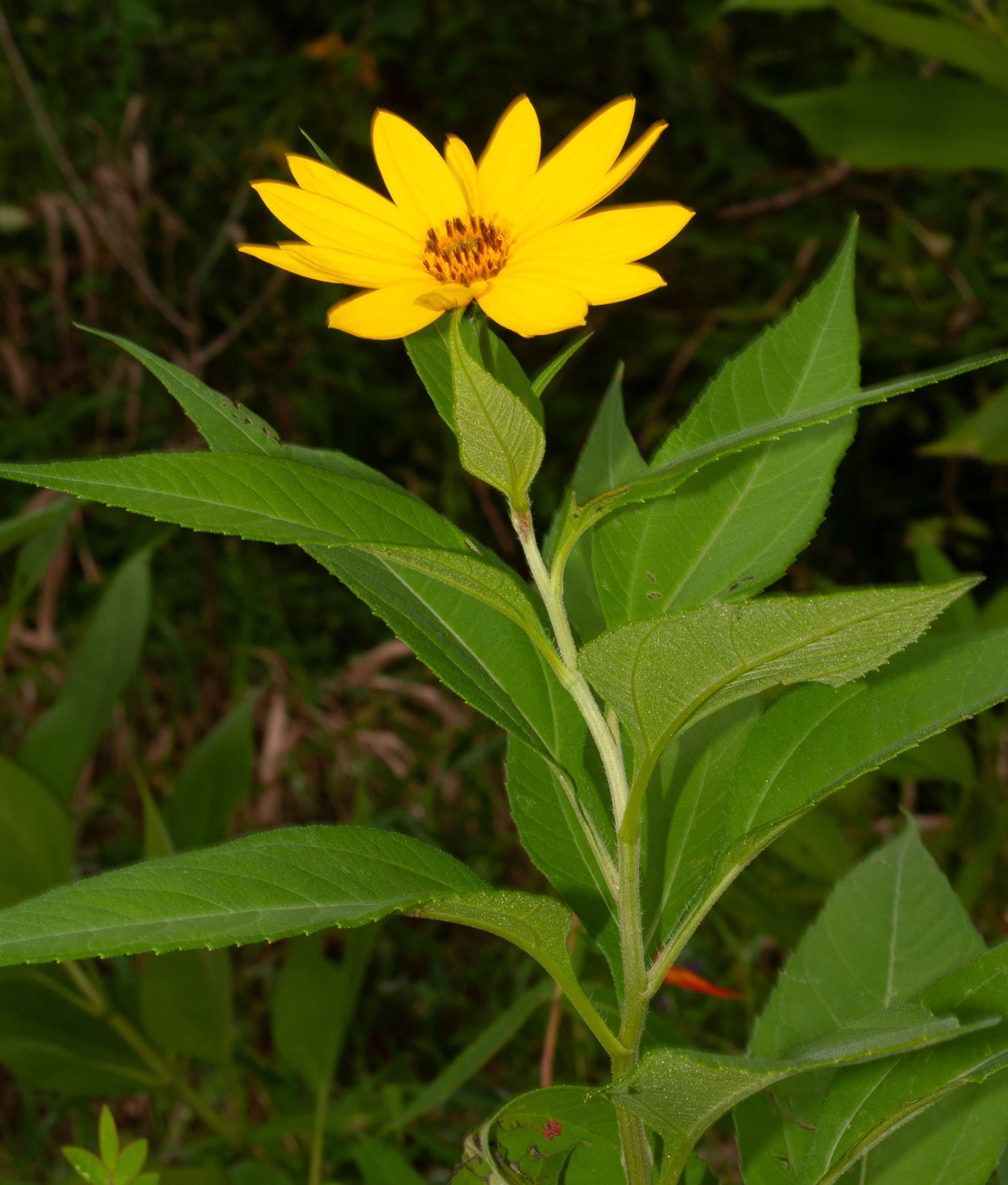
9/24/2011 · Nashua River Rail Trail, Groton Center, Groton, Massachusetts · ≈ 8 × 10″ (20 × 24 cm)  ID is uncertain


9/24/2011 · Nashua River Rail Trail, Groton Center, Groton, Massachusetts · ≈ 9 × 6″ (24 × 16 cm) ID is uncertain 
| Kingdom | Plantae | Plants, but not fungi, lichens, or algae (from Stearn's Botanical Latin) |
| Subkingdom | Tracheobionta | Vascular plants—plants with a “circulatory system” for delivering water and nutrients |
| Division | Magnoliophyta | Flowering plants, also known as angiosperms |
| Class | Magnoliopsida | Dicotyledons—plants with two initial seed leaves |
| Subclass | Asteridae | A large class that encompasses asters |
| Order | Asterales | Flowering plants with a central disk flower and surrounding petals, like daisies |
| Family | Asteraceae | The aster family, which also includes daisies and sunflowers; from the Greek ἀστήρ, “star,” for the star-shaped flowers |
| Genus | Helianthus | From Greek helios, “sun,” and anthos, “flower,” because it was believed that sunflowers turn to follow the sun |
| Species | tuberosus | “With tubers” (tubers are enlarged areas on the roots that store energy for the plant) |
Helianthus tuberosus description by Thomas H. Kent, not updated.

© FloraFinder.org. All rights reserved.
