Ocimum basilicum ‘Amethyst Improved’
Basil
This cultivar is not found in the wild. It is typically used as an ornamental plant, because of the unusual color of its leaves.
Plants: This cultivar of basil grows to 1–1½′ (38–50 cm). Stems and branches are square in cross-section.
Leaves: Shiny, deep purple leaves are almost black. The leaves are opposite, ovate in shape, 1–3″ (2.5–7.6 cm) long, curled, with green edges that look almost yellow in contrast to the rest of the leaf.
Flowers: Purple flower stalks have small racemes with white, pinkish, or purplish flowers ¼–½″ (8–13 mm) in size.
Fruits: Nutlets are about 1/16″ (2 mm) long, ellipsoid, black, and pitted.
Habitats: The natural plant originated in tropical Asia and Africa, and is now cultivated worldwide.
Edibility: Flowers taste strongly of basil, and may be used anywhere that calls for basil.
Online References:
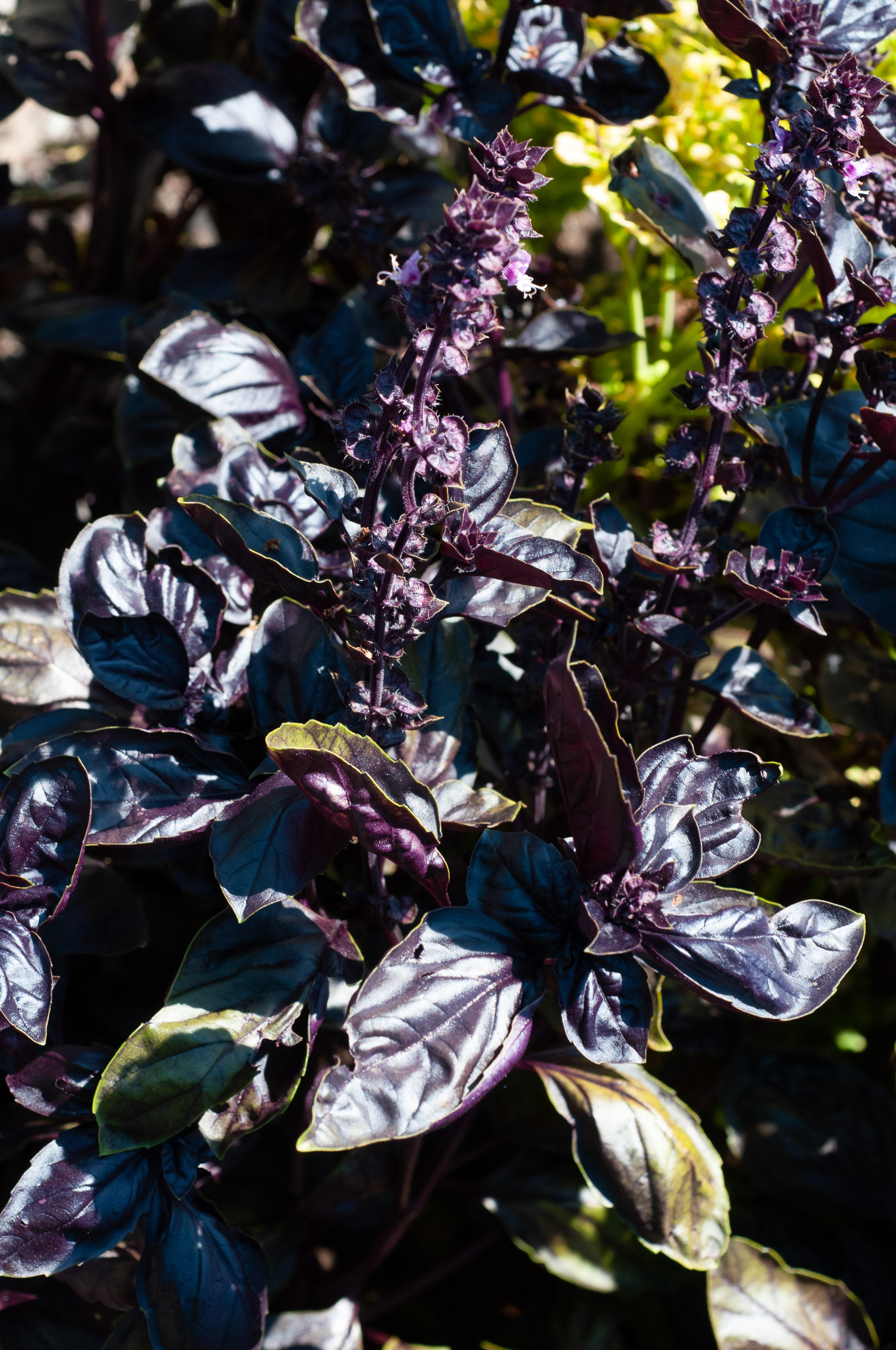
9/7/2010 · New England Botanic Garden at Tower Hill, Boylston, Massachusetts · ≈ 12 × 8″ (31 × 20 cm) 
| Kingdom | Plantae | Plants, but not fungi, lichens, or algae (from Stearn's Botanical Latin) |
| Subkingdom | Tracheobionta | Vascular plants—plants with a “circulatory system” for delivering water and nutrients |
| Division | Magnoliophyta | Flowering plants, also known as angiosperms |
| Class | Magnoliopsida | Dicotyledons—plants with two initial seed leaves |
| Subclass | Asteridae | A large class that encompasses asters |
| Order | Lamiales | Aromatic herbs and shrubs, including lavender, lilac, olive, jasmine, ash, teak, snapdragon, sesame, psyllium, garden sage, mint, basil, and rosemary |
| Family | Lamiaceae | Mint family |
| Genus | Ocimum | New Latin, from Latin, basil, from Greek ōkimon |
| Species | basilicum | From Latin basilicum, (“royal robe”), substantive of basilicus, (“royal, princely”) |
Ocimum basilicum ‘Amethyst Improved’ description by Thomas H. Kent, not updated.

© FloraFinder.org. All rights reserved.