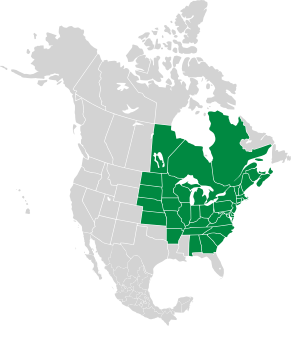
Washingtonia claytonii (Michx.) Britton
Osmorhiza claytonii (Michx.) C.B. Clarke
Sweet cicely, Clayton’s sweetroot, sweet jarvil, woolly sweet cicely
Sweet cicely is part of the same family that includes carrots and parsely. It is a native perennial of North America.
Plants: These plants grow in deciduous forests. Plants are 1–3′ (30–91 cm), with fuzzy stems and leaves.
Leaves: Large compound leaves are divided into threes twice or three times.
Flowers: Modest-looking flattish umbels, or clusters of white flowers, are divided further into unbellets, each with of 4-7 flowers. Individual flowers are ⅛″ (3.2 mm) around and have five tiny notched white petals.
Fruits: Fruits look like tiny brown beans ½–1″ (1.3–2.5 cm) long.
Habitats: Rich woods and wooded slopes.
Online References:
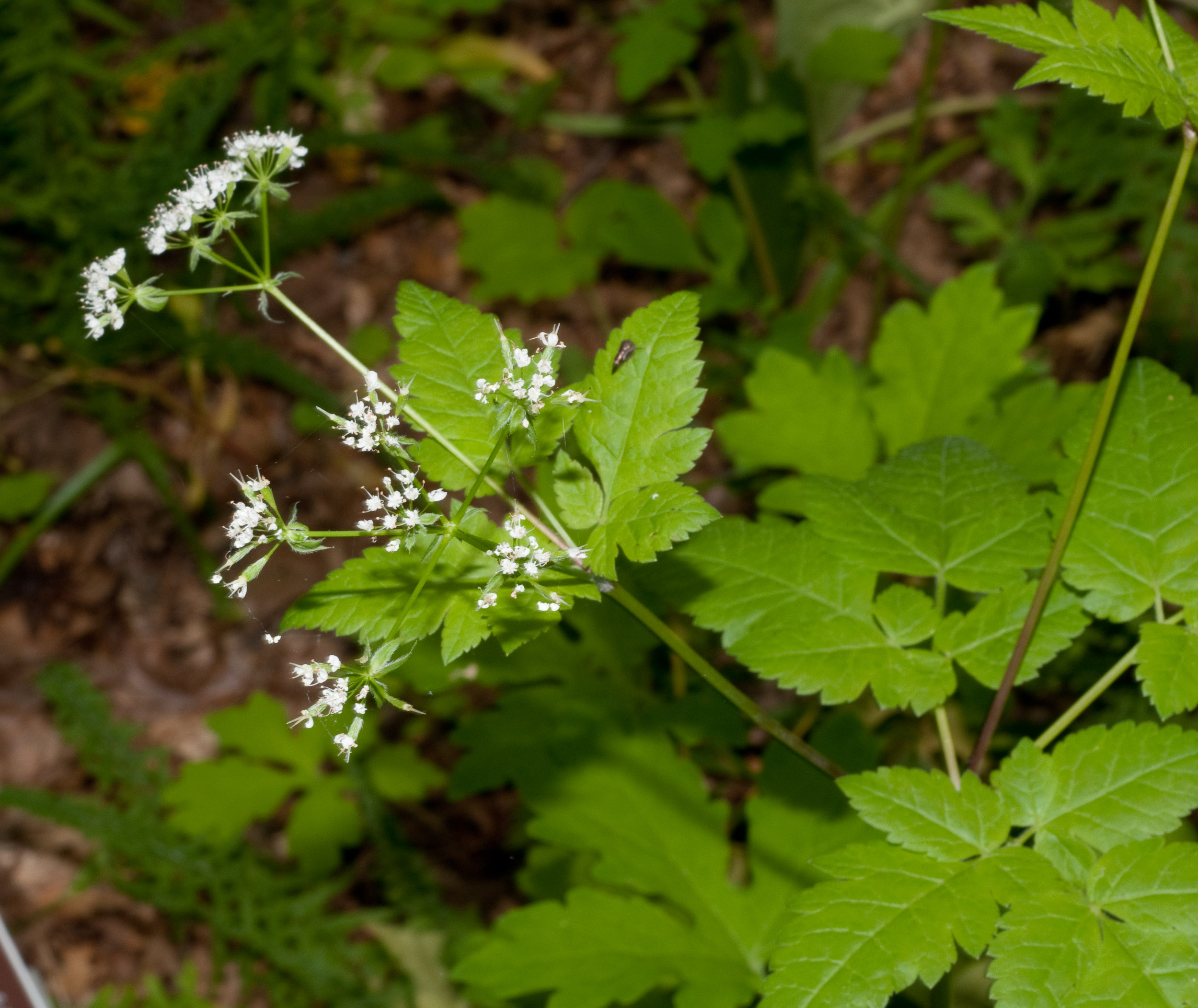
5/22/2010 · Garden in the Woods, Framingham, Massachusetts · ≈ 9 × 7″ (22 × 18 cm)  ID is uncertain

5/22/2010 · Garden in the Woods, Framingham, Massachusetts · ≈ 10 × 8″ (25 × 20 cm) ID is uncertain 
| Kingdom | Plantae | Plants, but not fungi, lichens, or algae (from Stearn's Botanical Latin) |
| Subkingdom | Tracheobionta | Vascular plants—plants with a “circulatory system” for delivering water and nutrients |
| Division | Magnoliophyta | Flowering plants, also known as angiosperms |
| Class | Magnoliopsida | Dicotyledons—plants with two initial seed leaves |
| Subclass | Asteridae | A large class that encompasses asters |
| Order | Apiales | Includes carrots, celery, parsley, and ivy |
| Family | Apiaceae | Carrot or parsley family, also includes angelica, anise, caraway, celery, chervil, cicely, coriander/cilantro, cumin, dill, fennel, hemlock, lovage, Queen Anne’s Lace, parsnip |
| Genus | Osmorhiza | From the Greek osme, “odor,” and rhiza, “root,” meaning “odorous root,” in reference to the fragrance of the crushed root |
| Species | claytonii | For John Clayton (1694-1773), an early botanist |
Osmorhiza claytonii description by Thomas H. Kent, not updated.

© FloraFinder.org. All rights reserved.