Polygonum arifolium L.
Halberd-leaved tearthumb, halberdleaf tearthumb
Similar species
Polygonum arifolium
Polygonum sagittatum
Polygonum perfoliatum


|
Polygonum arifolium L. Halberd-leaved tearthumb, halberdleaf tearthumb Similar species | |||
| You are here Polygonum arifolium |
Polygonum sagittatum |
Polygonum perfoliatum |
|
|---|---|---|---|
| Common Name | |
|
|
| Plant | This vinelike plant has weak stems that are green, pink or red, with many tiny backward-pointing barbs used to support it as it grows over other plants. Plants may be 2–4′ (60–121 cm) long. | Stems 3–6′ (91–182 cm) long, green, pink, or red, hollow, vinelike, with squared edges and tiny, backward-pointing prickles. | Vines have reddish stems with backward-pointing hooks that allow it to clamber over other plants. |
| Leaves | Shaped like arrowheads, except that the backward-pointing barbs point outward (technically, “hastate”). Leaves are hairy, 4–4½″ (10–11 cm) long. | Shaped like narrow arrowheads, attached via short ⅜″ (1 cm) stems. The base of each leaf tends to wrap around the stem. Leaf edges also have tiny prickles. | Mile-a-minute vine has leaves that are almost perfect triangles, small curved barbs along its stems, and saucer-shaped leaves (ocreas) at its stem nodes. Although ocreas are present in all Polygonums, they usually take the form of a fibrous sheath wrapped tightly around the plant stem. |
| Flowers | Flowerheads are less than ⅜″ (1 cm) in diameter, white to light pink in color. Each rounded flowerhead consists of 5-20 individual flowers at the end of a long stem, which emerges from a leaf node. | Flowerheads are less than ⅜″ (1 cm) in diameter, white to pink in color. Each rounded flowerhead consists of 5-20 individual flowers at the end of a long stem. | Flowers and fruits emerge from the ocreas. Flowers are white, but inconspicuous. |
| Fruit | Rounded reddish-brown nutlets about ⅛″ (3.2 mm) around. | Small nutlets, brown to black. | Tightly packed clusters of 10-30 lobed metallic blue fruits, each about ⅛–¼″ (3.2–6.3 mm) around. Each lobe or segment contains a single glossy, black or reddish black seed. |
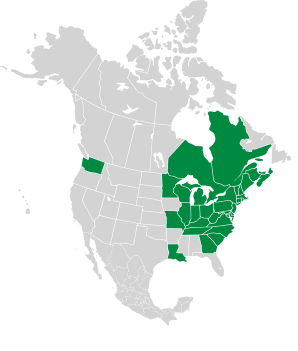
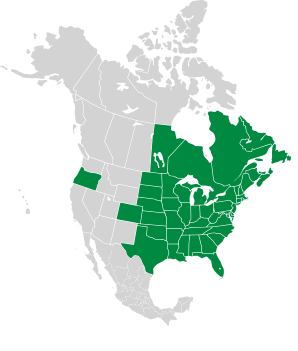
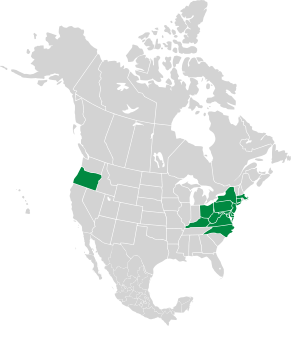
| Range/ Zones |
|
|
|
| Habitats | Marshes, swamps, wet meadows. | Wet, marshy ground. | Almost anywhere there are warm moist or wet open areas: woods, wetlands, roadsides, fields, stream banks, forest edges. |
Polygonum arifolium description by Thomas H. Kent, not updated.
© FloraFinder.org. All rights reserved.