Polyporus squamosus (Huds. : Fr.) Fr. 1821
Dryad’s saddle, pheasant’s back mushroom
Dryad’s saddle is native to Australia, Eurasia, and North America. Who or what is a Dryad? Turns out a dryad (Greek: Δρυάς) is an oak tree nymph or spirit in Greek mythology. This mushroom might have made a comfy saddle for such a being.
Identification: This is both saprobic, growing on dead stumps and logs; and parasitic, growing on living trees. Fruits are relatively large 1¾–12″ across ⨉ ⅜–1½″ thick (5–30 ⨉ 1–4 cm) and kidney- or fan-shaped, and depressed in the center, like a saddle. They have cream to tan coloration, flattened scales (squamules) on the cap, white flesh, and, on mature specimens, a black and velvety stem base. Tubular undersides are ⅜″ (1 cm) deep. Stems are ⅜–1¾ ⨉ ⅜–1½″ (1–5 ⨉ 1–4 cm). It has a mealy odor some liken to watermelon rind. Spores are oblong-ellipsoidal in shape, smooth, and measure approximately 10-15 x 4-5.5µm. They produce a white spore print.
Habitats: Hardwood stumps, logs, and living trees, on many species of trees, especially silver maple and box elder in eastern North America, and quaking aspen in western North America.
Edibility: Edible when young, but not everybody likes them and they cause digestive upset for some.
Online References:
References:
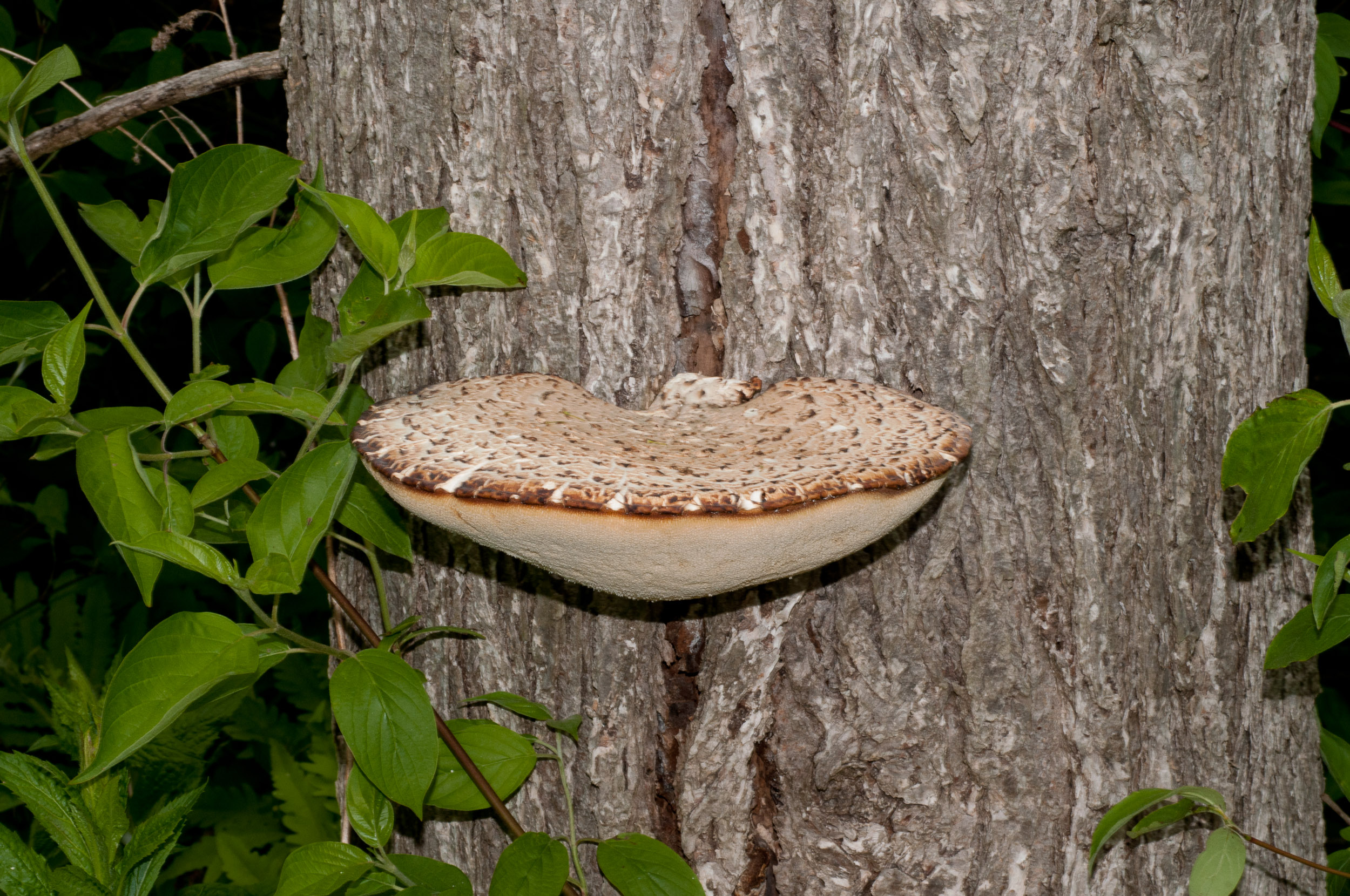
5/29/2010 · Maine Audubon Gilsland Farm Audubon Center, Falmouth, Maine · ≈ 1½ × 1′ (52 × 34 cm)  ID is uncertain

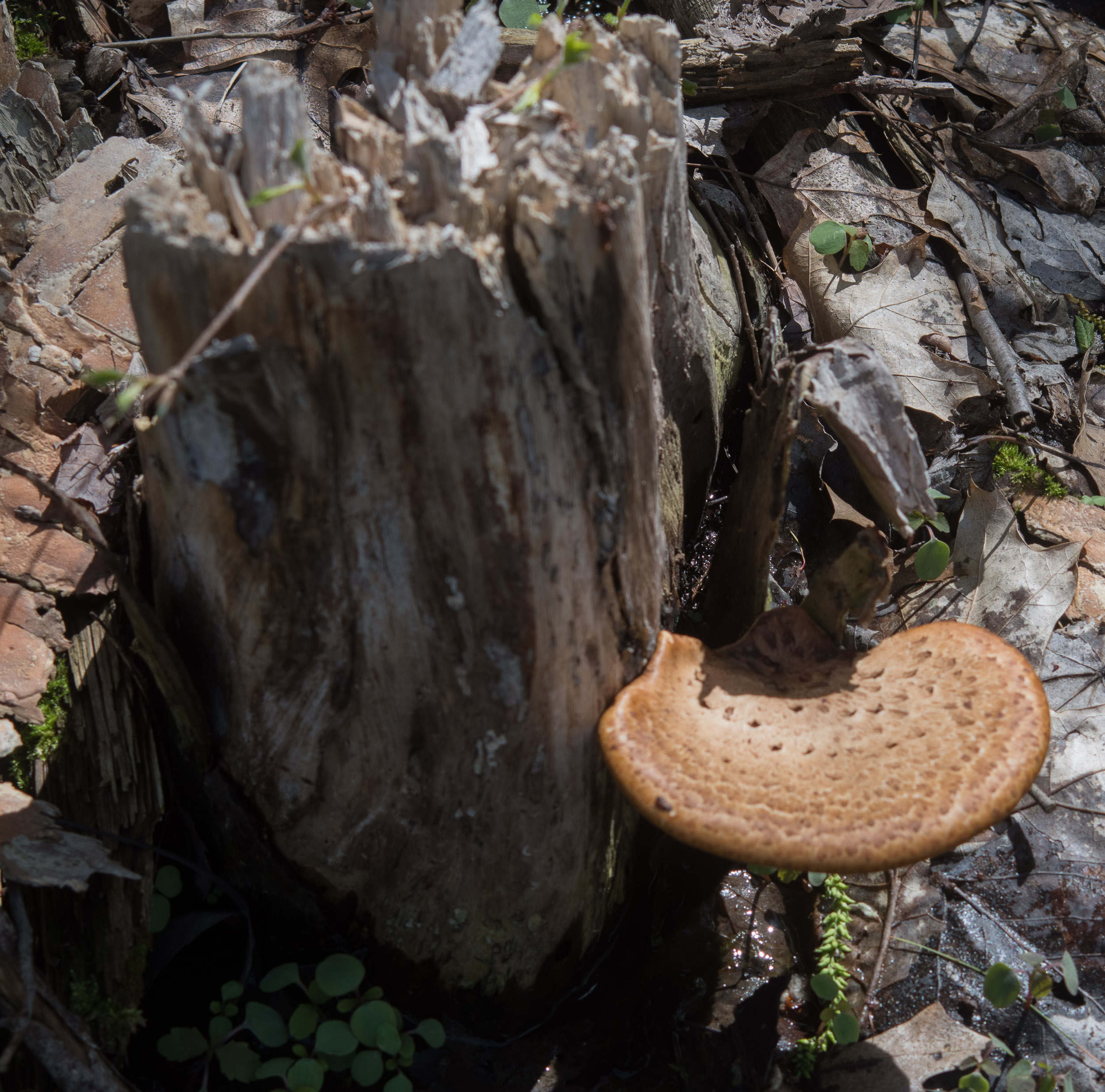
5/4/2017 · Nashua River Rail Trail, Groton Center, Groton, Massachusetts 

5/29/2010 · Maine Audubon Gilsland Farm Audubon Center, Falmouth, Maine · ≈ 15 × 10″ (39 × 26 cm) ID is uncertain 

6/1/2010 · Nashua River Rail Trail, Groton Center, Groton, Massachusetts · ≈ 17 × 12″ (44 × 29 cm) 

6/13/2025 · River Point Conservation Area, Falmouth, Maine 
| Roughly 75 people in North America are poisoned each year by mushrooms, often from eating a poisonous species that resembles an edible species. Though deaths are rare, there is no cure short of a liver transplant for severe poisoning. Don’t eat any mushroom unless you are absolutely certain of its identity! Please don’t trust the identifications on this site. We aren’t mushroom experts and we haven’t focused on safely identifying edible species. |
Polyporus squamosus description by Thomas H. Kent, not updated.

© FloraFinder.org. All rights reserved.