Quercus gambelii Nutt.
Gambel oak
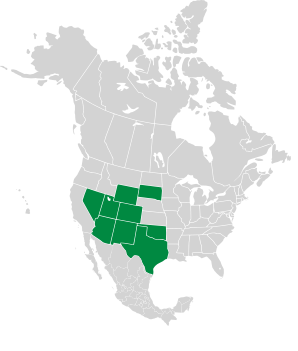
Gambel oak is native to the lower mountains and foothills of western North America.
Plants: Trees are 9½–30′ (3–9 m), though in ideal conditions, they can reach double this height. The largest recorded specimen, in Arizona, is 115′ (35 m) tall. Bark is red-brown to gray.
Leaves: 2½–4½ ⨉ 1½–2″ (7–12 ⨉ 4–6 cm), deeply or moderately lobed. They are obovate to oblong-obovate. Leaf stalks (petioles) are ½–¾″ (1.3–1.9 cm) long. The upper surface is glossy and dark green, while the lower surface is pale and velvety.
Flowers: Insignificant greenish or brownish staminate (male) or pistillate (female) catkins. Flowers appear from April to June.
Fruits: Light brown acorns are ⅜–¾″ (1–2 cm), with ⅓ to ½ covered by a cap. They may be single or in small clusters.
Habitats: At elevations of 3281–9843′ (1–3 km), on sunny hillsides with thin, rocky, alkaline soil. They appear on slopes, in canyons and foothills.
 |
Similar species. |
Online References:

8/28/2014 · High Road to Taos, New Mexico · ≈ 2½ × 1½′ (79 × 53 cm) 

8/28/2014 · High Road to Taos, New Mexico · ≈ 2 × 1½′ (67 × 46 cm) 
| Kingdom | Plantae | Plants, but not fungi, lichens, or algae (from Stearn's Botanical Latin) |
| Subkingdom | Tracheobionta | Vascular plants—plants with a “circulatory system” for delivering water and nutrients |
| Division | Magnoliophyta | Flowering plants, also known as angiosperms |
| Class | Magnoliopsida | Dicotyledons—plants with two initial seed leaves |
| Subclass | Rosidae | Roses, legumes, proteas, dogwoods, hydrangeas, mistletoes, euphorbias, grapes, many more |
| Order | Fagales | Birch, she-oak, beech, walnut, bayberry, others |
| Family | Fagaceae | Beech familhy |
| Genus | Quercus | Latin for “oak” |
| Species | gambelii | After William Gambel (1821-1849), an assistant curator at the Natural (now National) Academy of Sciences and an avid western plant collector |
Quercus gambelii description by Thomas H. Kent, not updated.

© FloraFinder.org. All rights reserved.