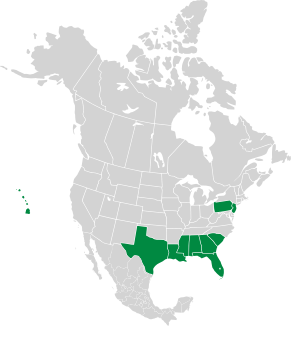
Sida acuta Burm. f. var. carpinifolia (L. f.) K. Schum.
Sida carpinifolia L. f.
Sida acuta Burm. f.
Common wireweed
Common wireweed probably originated in Central America, but is now widespread in tropical habitats in both the northern and southern hemispheres. The name wireweed refers to the plant’s fibrous stems, which make it nearly impossible to pull up. It can be weedy, and is invasive in many habitats.
Plants: A perennial densely branched shrub. Stems are fibrous and almost woody.
Leaves: Alternate and smooth-edged. Usually lanceolate to linear, sometimes ovate to oblong. They have coarse teeth and sharp tips, and prominent veins on leaf undersides. They are on stalks (petioles) 1/16–3/16″ (3–6 mm) long. Leaves are ¾–3½″ long ⨉ ⅛–1½″ wide (2–9 cm ⨉ 5–40 mm).
Flowers: Yellow, roughly star-shaped, usually solitary (sometimes up to 3), ⅜–¾″ (1–2 cm) around, with five petals.
Fruits: A hard, brown capsule, 1/16–3/16″ (3–5 mm) around. It breaks into 5-8 triangular segments, each of which has one seed and a pair of sharp awns 1/32″ (1 mm) long. These attach readily to animal fur or clothing. Seeds are small, reddish-brown to black, wedge-shaped, deeply indented on both sides, and about 1/32″ (1.5 mm) long.
Habitats: Disturbed habitats in tropical and subtropical regions—degraded pastures, tree planations, agricultural lands, roadsides, waste places, especially near watercourses.
Edibility: Not edible. Contains ephedrine, toxic in significant quantities. A popular browse for many animals.
Medical: Oft-used for folk medicine, this species and other members of the genus show promise for modern medical applications.
Online References:
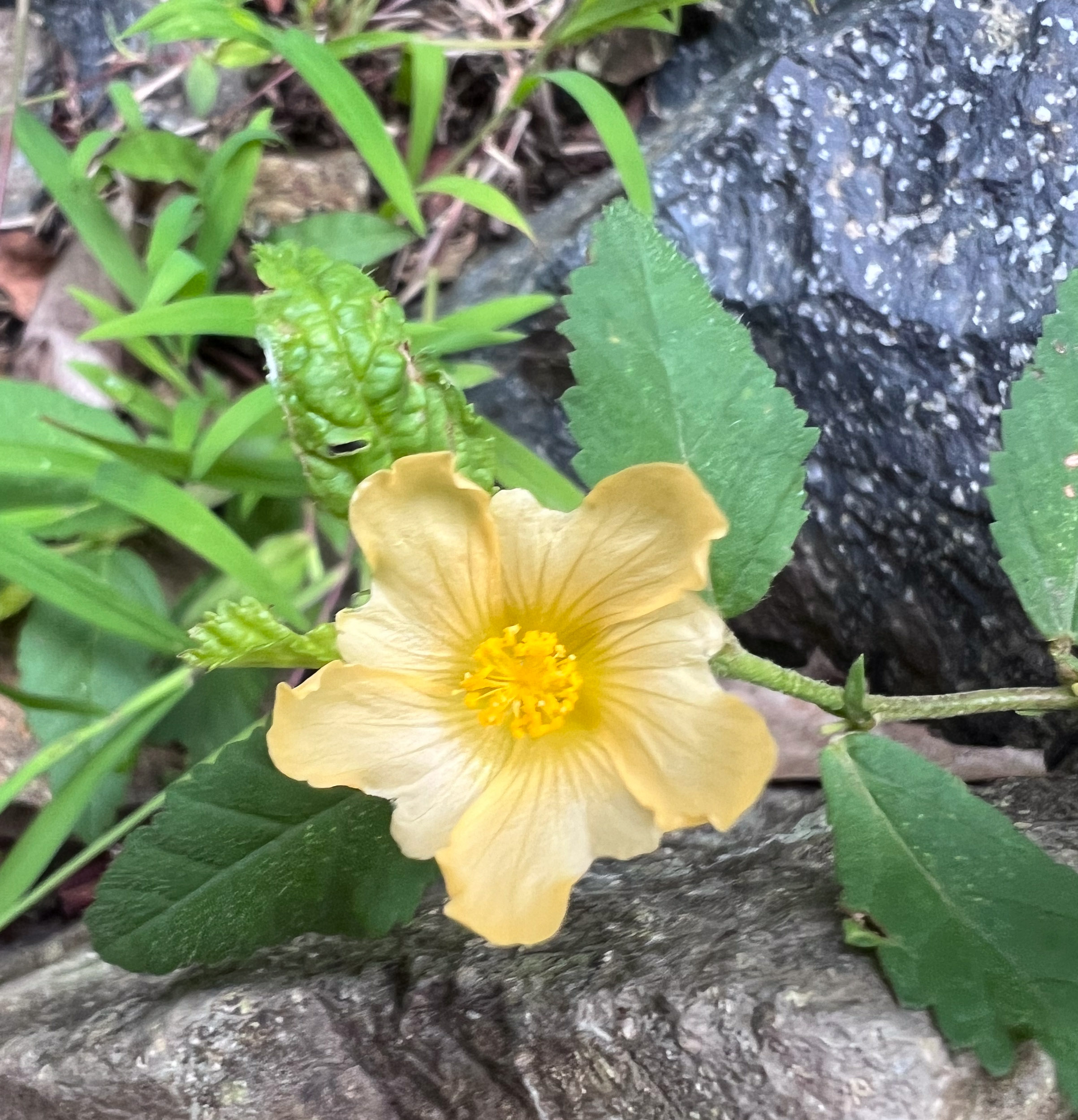
6/5/2024 · Saint Marten, Leeward Islands · By Heather A. Kent 
| Kingdom | Plantae | Plants, but not fungi, lichens, or algae (from Stearn's Botanical Latin) |
| Subkingdom | Tracheobionta | Vascular plants—plants with a “circulatory system” for delivering water and nutrients |
| Division | Magnoliophyta | Flowering plants, also known as angiosperms |
| Class | Magnoliopsida | Dicotyledons—plants with two initial seed leaves |
| Subclass | Rosidae | Roses, legumes, proteas, dogwoods, hydrangeas, mistletoes, euphorbias, grapes, many more |
| Order | Malvales | Includes cacao, balsa, lime, linden, basswood, daphnes, hibiscus, hollyhocks, okra, baobab, cotton, kapok, and many others |
| Family | Malvaceae | Includes okra, jute, cacao, hibiscus, many others |
| Genus | Sida | An ancient Greek name used by Theophrastus for the water lily |
| Species | acuta | With a sharp but not tapering point |
Sida acuta description by Thomas H. Kent, not updated.

© FloraFinder.org. All rights reserved.