Cereus chacoanus Vaupel 1916
Stetsonia coryne (Salm-Dyck) Britton & Rose 1920
Toothpick cactus, cardón, tuna
Toothpick cactus is native to dry, regions of Argentina, Bolivia and Paraquay. Sources differ considerably on elevations at which these cacti are found, ranging from “low deserts” to “high arid regions.” It is not found in the wild in North America. The genus, Stetsonia, honors the American lawyer and enthusiastic botanical explorer, Francis Lynde Stetson; coryne, meaning “stick” or “club,” probably refers to the clublike appearance of the stems.
Plants: Large shrubs 16–26′ (5–8 m) high, with multiple thick trunks. Stems are bluish gray, 3½–4″ (9–10 cm) in diameter, with 8-9 ribs and few segments. Spines are initially yellow, becoming black, with a central spine up to 1¾″ (5 cm) and 7-9 shorter surrounding spines.
Flowers: Funnel-shaped white flowers with yellow-white centers, up to 6″ (15 cm) in size, open at night.
Fruits: Globular, smooth (no spines), juicy, yellowish or reddish, 1¾–2″ long ⨉ 1½″ around (5–6 ⨉ 4 cm).
Habitats: High altitude arid regions in South America.
Edibility: Contains mescaline, a hallucinogen, and other alkaloids.

Toothpick cactus (Stetsonia coryne); Cactus family (Cactaceae); native to Peru, Chile, Argentina, Bolivia. Photographed at the Desert Botanical Garden, Phoenix, AZ. By Dave Pape. 
Online References:
References:
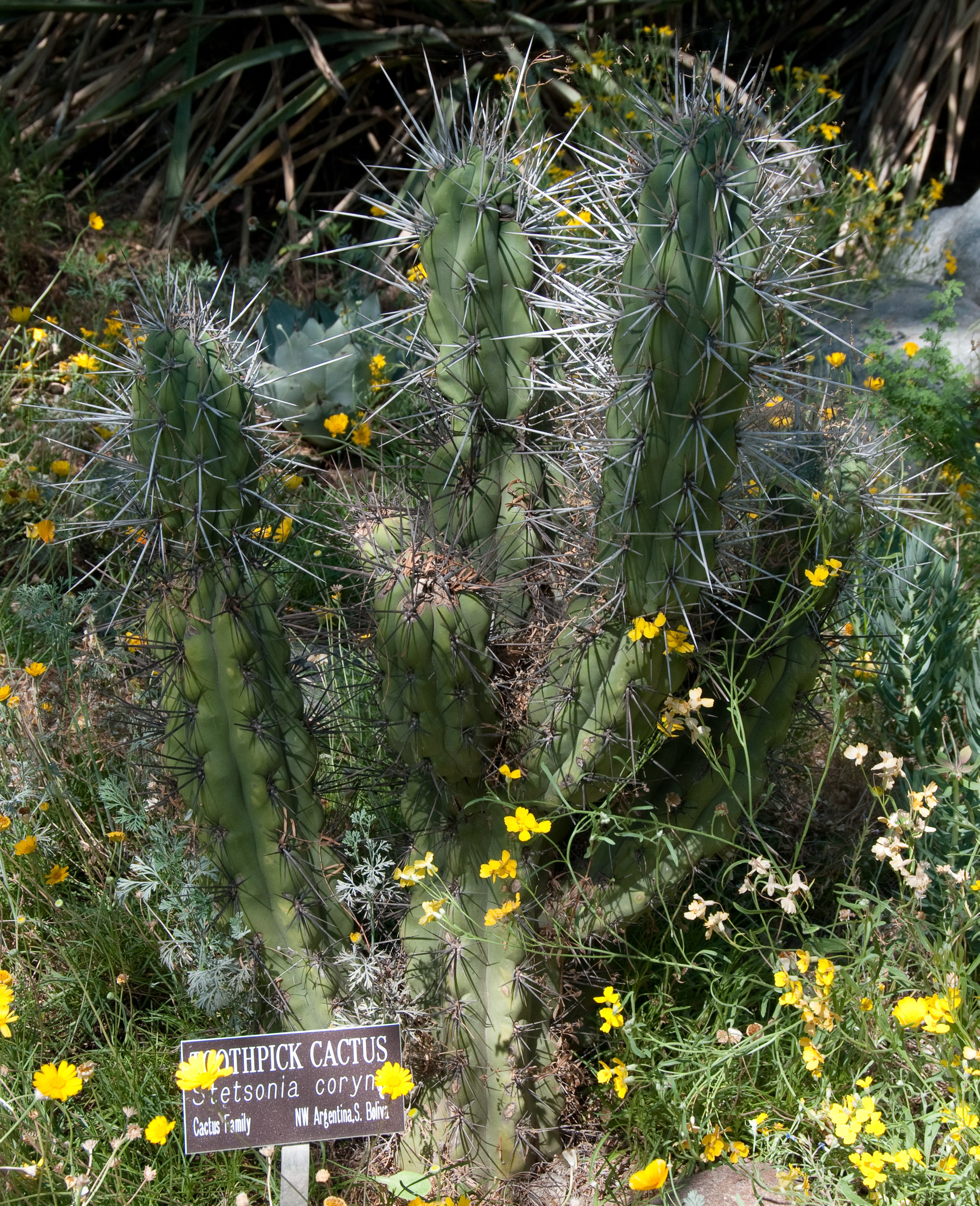
5/25/2009 · Boyce Thompson Arboretum, Superior, Arizona 
| Parents | Unknown | Genus is not in the current taxonomy |
| Genus | Stetsonia | Named by Britton and Rose after Francis Lynde Stetson, a New York lawyer and gardener |
| Species | coryne | From Greek koryne, ”club,“ for the clublike trunk |
Stetsonia coryne description by Thomas H. Kent, not updated.

© FloraFinder.org. All rights reserved.
