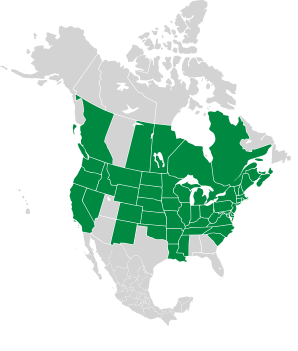
Typha angustifolia L. var. elongata (Dudley) Wiegand
Typha angustifolia L.
Narrow-leaved cattails, narrowleaf cattail, lesser bulrush, lesser reedmace
Narrowleaf cattail is now common in North American fresh to brackish wetlands, but it may originally have come from Europe. The straplike leaves may be woven into mats and chairs, as well as thatch.
Plants: A stiff unbranched stem 3–7′ (91–213 cm) tall is light green to green, and round.
Leaves: Up to four straplike leaves (up to 16 by some accounts), each 1½–6′ (45–182 cm) long, parallel the stem, or spread slightly away from it. They are very narrow, only ⅛–⅜″ (3–12 mm) across, and flat. Leaves attach to the base of the plant, resembling giant blades of grass, and having similar parallel leaf veins. Viewed in cross-section, the leaves are slightly bent into a crescent shape.
Flowers: A dense, dark brown nearly perfect cylinder perches vertically atop each stem, like a dark brown hot dog skewered for the campfire. Well actually two hot dogs, separated by 1–3″ (2.5–7.6 cm) of stem. The upper flower spike is lighter in color and narrower, and is the male (staminate) portion; while the lower female (pistillate) spike is green, turning to dark brown. Flowers appear from May to June.
Fruits: As the flowers mature they become soft and light tan in color, releasing tiny nutlets borne on soft hairs.
Habitats: Marshes, wetlands, and along the edges of ponds and lakes.
Edibility: Dormant sprouts on roots and leaf bases, the inner core of the stalk, green bloom spikes, and starchy roots are edible. Roots may be boiled like potatoes.
Online References:
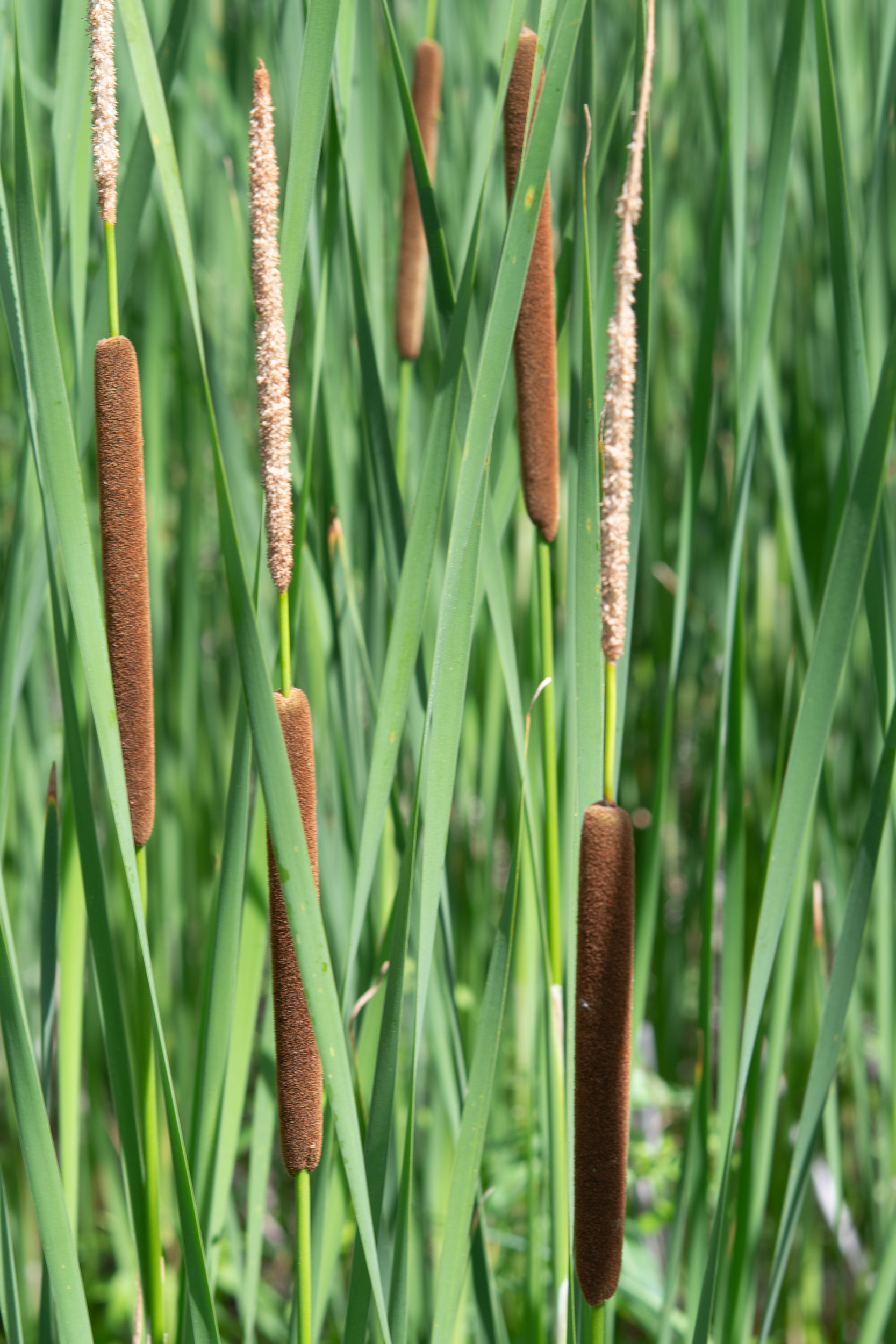
7/2/2016 · Nashua River Rail Trail, Groton Center, Groton, Massachusetts · ≈ 10 × 15″ (26 × 39 cm) 
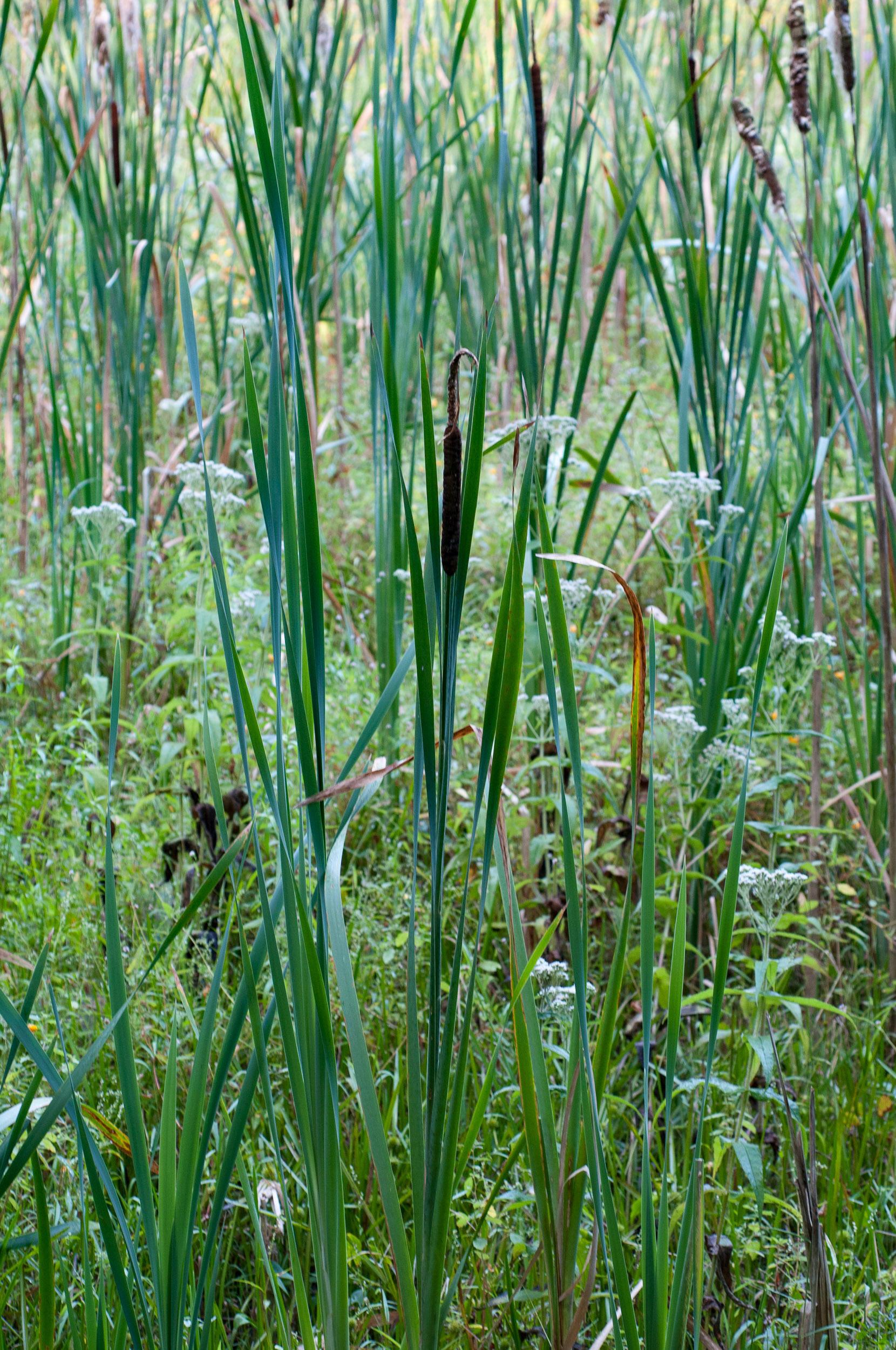
8/20/2009 · Hayes Woods Nature Trail, Shirley St., Pepperell, Massachusetts  ID is uncertain
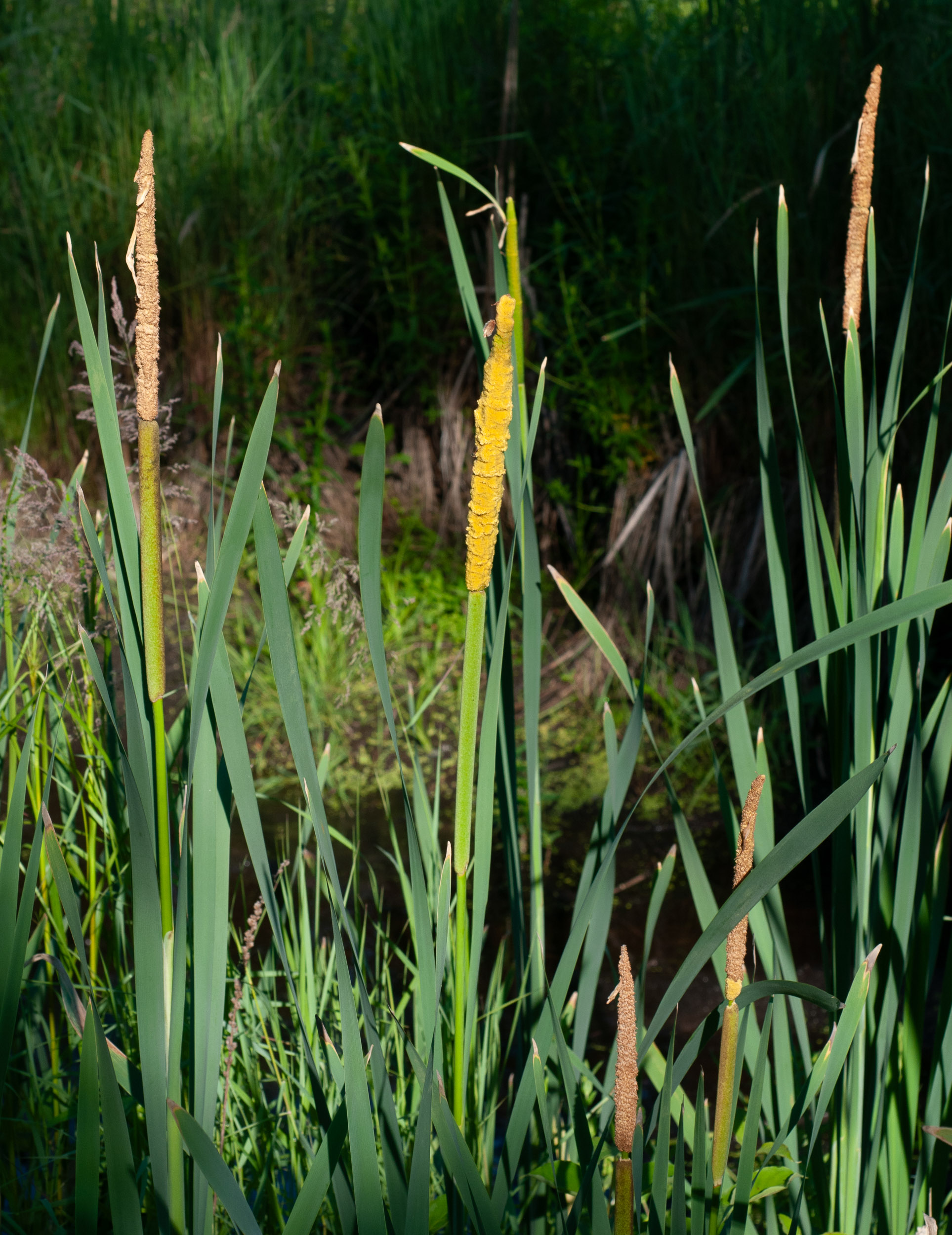
6/21/2010 · Nashua River Rail Trail, Groton Center, Groton, Massachusetts ID is uncertain 

7/2/2016 · Nashua River Rail Trail, Groton Center, Groton, Massachusetts · ≈ 8 × 12″ (20 × 31 cm) 

7/2/2016 · Nashua River Rail Trail, Groton, Groton, Massachusetts 
| Kingdom | Plantae | Plants, but not fungi, lichens, or algae (from Stearn's Botanical Latin) |
| Subkingdom | Tracheobionta | Vascular plants—plants with a “circulatory system” for delivering water and nutrients |
| Division | Magnoliophyta | Flowering plants, also known as angiosperms |
| Class | Liliopsida | Monocots (plants with a single seed leaf); includes the lily family |
| Subclass | Commelinidae | Dayflowers and spiderworts, and several others |
| Order | Typhales | A group including reedlike wetland plants such as cattails |
| Family | Typhaceae | Plants, such as cattails, with a single flower spike that has both male and female flowers |
| Genus | Typha | From Greek tufh (typhe), “cattail” |
| Species | angustifolia | “Having narrow foliage” |
Typha angustifolia description by Thomas H. Kent, not updated.

© FloraFinder.org. All rights reserved.