Zizia aptera (A. Gray) Fernald
Heart-leaved golden alexander, meadow zizia
Two golden alexanders
Zizia aptera
Zizia aurea


|
Zizia aptera (A. Gray) Fernald Heart-leaved golden alexander, meadow zizia Two golden alexanders | ||
| You are here Zizia aptera |
Zizia aurea |
|
|---|---|---|
| Common Name | |
|
| Plant | Up to 1–3′ (30–91 cm) in height, with single or multiple stems. | Up to 1–2′ (30–60 cm) in height. |
| Leaves | Basal leaves are heart-shaped, with rounded or blunt tips and long stalks. Upper leaves are compound, split into three leaflets or nearly unlobed. All leaves are serrated. upper leaves in two. Leaves are up to 4″ (10 cm) long and 3″ (7.6 cm) wide, heart-shaped, with finely toothed edges. | Alternate leaves are compound, and up to 8 ⨉ 5″ (20 ⨉ 12 cm) in size. Basal leaves are divided into threes; upper leaves in two. Upper leaves are up to 2½″ (7 cm) long and ⅞″ (2.5 cm) wide, with toothed edges. |
| Flowers | Flowerheads have the overall shape of a flat or gently curved umbrella about 1½–3″ (3.8–7.6 cm) across, divided into 7-15 (umbellets). The smaller groups contain approximately 25 tiny yellow flowers, each less than ⅛″ (3.2 mm) across, each with five petals that remain nearly closed, and five yellow stamens. | Flowerheads have the overall shape of a gently curved umbrella, divided into smaller groups. The smaller groups—umbellets—contain approximately 25 tiny yellow flowers. Each flower is less than ⅛″ (3.2 mm) across, with five petals, five sepals, and five stamens. Flowers appear from May to June. |
| Fruit | Slightly flattened ovals, with two ridged sections that split into seeds. The seeds are ⅛″ (3 mm) long, and brown when mature. | Oblong green fruit capsules, 1/16–⅛″ (3–4 mm) long, become purple when dry. |
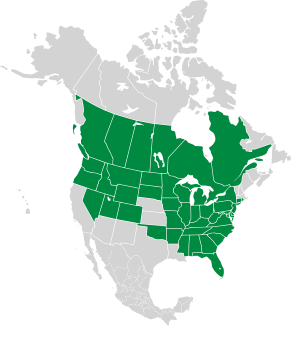
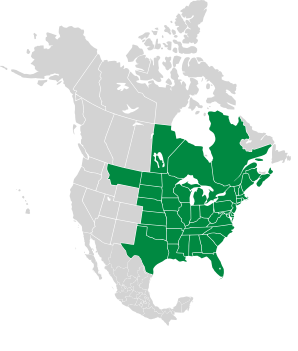
| Range/ Zones |
|
|
| Habitats | Black soil prairies, hillside prairies, rocky upland woodlands, limestone glades, bluffs, abandoned fields, and roadsides | Moist black soil prairies, moist to mesic woodland openings, savannas, thickets, limestone glades and bluffs, power line clearings, and abandoned fields. |
Zizia aptera description by Thomas H. Kent, not updated.
© FloraFinder.org. All rights reserved.