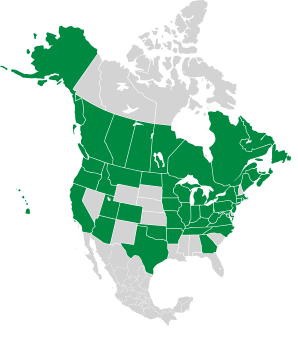
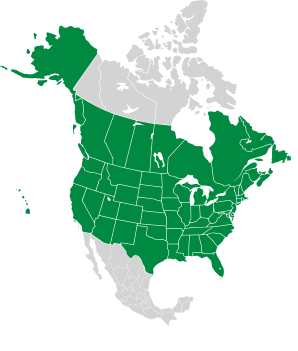
Plants are 8–24″ (20–60 cm) high. Leaves and stems produce a milky latex when broken.
Plants consist of a basal rosette with 3-8 or more leaves, and many tall, thin relatively bare flower stems 10–36″ (25–91 cm) high. Stems, leaves, and stolons exude a milky latex when cut. Stems have dense hairs1/32–⅛″ (1–4 mm) long, softer toward the bottom, stiffer toward the top.
Plants are 6–60″ (15–152 cm) in height, with leafy stems, the lower part of which have long hairs. Upper stems are fuzzy. Stems, leaves and stolons secrete a milky latex when cut.
Leaves
Leaves are mostly at the bottom, spatula-shaped and very fuzzy, up to 5″ (12 cm) long.
Basal leaves are 2–10″ (5–25 cm) long and ½–1¼″ (1.3–3.2 cm) wide. They are variable in appearence, oblonglanceolate to elliptic in shape, with blunt or pointed tips, sometimes toothed.
Alternate, lanceolate to elliptic, smooth and greenish gray on top, hairy and rough below. Leaves are pointed, with sparse, unevenly spaced sharp teeth. Leaves attach directly to stems, sometimes partially clasping the stems.
Flowers
Bright orange (the only orange hawkweed), with paler orange centers, in small clusters atop tall stems. Flower rays have squared-off, serrated tips. Flowers are ½–¾″ (1.3–1.9 cm) around.
Stems are topped with a flat- or umbrella-shaped cluster of 5-30 yellow flowers. Flowers appear from May to August, and are ½–1″ (1.3–2.5 cm) across.
In loosely branched clusters. Each flower is about 1″ (2.5 cm) across, with 30 or more florets.
Fruit
Dry seeds that ripens to black, with a tuft of light brown hair for wind dispersion.
10–36″ (25–91 cm) tall, with a single stem that exudes a milky sap when broken. The stem has stiff hairs.
12–18″ (30–45 cm) in height, rarely up to 2½′ (80 cm), with hairy stems. Stems, leaves, and stolons secrete a milky sap when cut.
Plants are 4–36″ (10–91 cm) tall. Flowering stems have scattered black hairs tipped with glands. Broken stems exude a milky latex.
Leaves
Three to eight leaves are basal, lying almost flat, each 1–6″ (3–15 cm) long. The basal leaves are lanceolate to oblanceolate, with smooth or very slightly toothed margins. Leaf tips may be rounded or sharp. There may be up to two leaves on the stem. All the leaves have stiff hairs.
Basal leaves are lanceolate to elliptic, hairy or smooth, 1¾–6 ⨉ ⅜–1¾″ (5–15 ⨉ 1–5 cm), with toothed margins. Leaf bases, usuallly cuneate, may also be rounded or squared. Leaves decrease in size further up the stems. Broadly elliptic, 1¾–4″ (5–10 cm) long.
Flowers
Crowded clusters of 5 to 25 yellow flowers. Each flower has 25-50 florets ⅛–⅜″ (3–10 mm) long, with five teeth at the end of each floret. They bloom in June and July.
Flower heads have 25-50 flowers, and take the form of thyrse—a raceme composed of several branching cymes. Each flower is yellow, ½–1″ (1.3–2.5 cm) across, with 20-40 rays. (An otherwise similar species, Hieracium scabrum, has 40-100 rays.) Flowers appear Jul to Oct.
Flowerheads are grouped near stem tips. Each flower is ⅜–¾″ (1–2 cm) around, with 40-80 ray florets and no disc florets. Each floret is ½–⅝″ (1.3–1.8 cm) long. Flowers appear all summer.
Fruit
Pappi, with white bristles, are ⅛–3/16″ (4–6 mm) long. The fruits (cypselae) are columnar, and about 1/32″ (1.5 mm) long.
Spindle-shaped achenes, tapering at both ends, how brown tufts of hair for wind dispersal.
Dark brown achenes are cylindrical and 1/16–⅛″ (2.5–3.5 mm) long. Each seed has a pappus composed of 30 to 40 bristles.
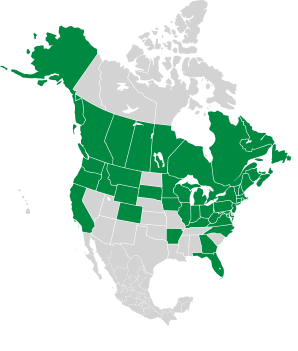
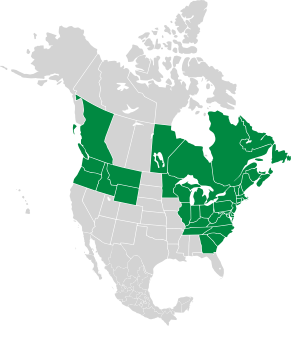
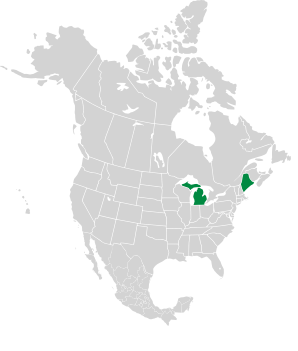
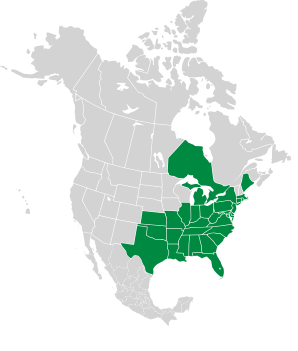
Range/ Zones
Habitats
Fields, roadsides, disturbed soils.
Dry prairies, savannas, fields, or roadsides; openings in beech-maple forests; sandy soils.
These hawkweeds aggressively colonize low-nutrient soils, including disturbed soils, meadows, trail edges, and fields.
Plants are 10–24″ (25–60 cm) in height, with hairy stems. 3-6 leaves appear at the base of the plant, sometimes with two or three more on the stems.
From a base on the ground that survives the winter, this hawkweed produces stems up to 3′ (1 m) high, with sparse leaves and hairs on the lower stem and leaves that are ⅛–⅜″ (3–10 mm) long.
Exceptionally hairy, even for hawkweeds, especially the leaves, whose undersides are soft enough to have earned the name "mouse ears." Upper leaf surfaces are also covered with coarser long white hairs.
Leaves
Elliptic, 1¾–4″ (5–11 cm) × ⅞–1¾″ (2.5–4.5 cm), sometimes mottled with purple. Unusual in shape, wide at the base, with large, forward-pointing teeth that fall somewhere between the designation of "tooth" vs. "lobe."
Leaves are narrow, with irregularly toothed margins and whitish undersides.
Plants have a basal rosette of leaves which are unlobed, elliptic, pointed to blunt, and ⅜–4″ (1–10 cm) × ⅛–¾″ (5–20 mm). Leaves have a prominent white midvein.
Flowers
Flower heads appear as 5-8 corymbs. Flowers are yellow, with 30-50 or more florets, about ½″ (1.3 cm) in size. They flower in June.
The top portion of the plant branches in a delicate tracery of sinuous, hairless, thin-branched flowering heads. Each of the dozens of flowers are less than ½″ (1.5 cm) in length, with less than 20 florets.
Solitary yellow flowers appear 1¾–20″ (5–50 cm) above the base of leaves, on stems with stiff dark hairs and no leaves, each flower up to 1″ (2.5 cm) across. They appear Jun-Sep.
Fruit
Cypselae are columnar, and 1/16–⅛″ (2.5–3 mm) long.
Up to 2′ (65 cm) tall. Stems have hairs 1/16–⅛″ (2–3 mm) long.
Up to 3½′ (1 m) tall. Hairs on stems and leaves make it feel rough to the touch. Stems are unbranched and leafy.
Plants are 6–60″ (15–152 cm) in height, either hairy or hairless. A stiff major stem is often reddish and somewhat ridged.
Leaves
Alternate, Usually toothed, with cuneate bases. Most hawkweeds have basal leaves, but New England hawkweed’s leaves are all cauline—growing on the stem. They are approximately lanceolate in shape, and 1–3 ⨉ ⅜–⅞″ (3–8 ⨉ 1–2.5 cm).
There are a few short-stalked basal leaves, but most are cauline—on the stem. Leaves are alternate, 2–8 ⨉ ½–2″ (5–20 ⨉ 1.3–5 cm), decreasing in size further up the stem, and oval-elliptic in shape, tapering to a dull point. Larger leaves may have a few irregular teeth.
Oval or round, ⅜–6″ (1–15 cm) × ⅜–2½″ (1–7 cm). Each leaf has a large roughly triangular (deltate) lobe at the end, often with two smaller side lobes at the base that vaguely resemble nipples. Lower leaves also have a long petiole that is slightly winged and hairy.
Flowers
Flowerheads contain 25-30 or more flowers. Each flower has 40-60 ray florets only, no disc florets. Flowers appear in August to September.
A single stem is topped with a heavily branched array of 5-50 flower heads, which may be conical or flattish in shape and up to 1′ (30 cm) high. Each flower is ½–1″ (1.3–2.5 cm) around, with 30-60 ray florets, but no disc florets. Flowers appear in late summer.
Panicles of 5-25, rarely as high as 100, each flower ¼–½″ (6.3–12 mm) across, with 18-20 pale yellow rays. Paler than hawkweed flowers, and significantly different at close range. Appear Apr-Sep.
Fruit
Cypselae are columnar, 1/16–⅛″ (2.5–3 mm), with pappi (little parachutes) with about 60 bristles.
Florets are replaced by achenes with tufts of tan hair. Mature achenes are about ⅛″ (3 mm) long, narrowly cylindrical in shape, truncate at the apex, and dark brown.
Range/ Zones
Habitats
Fields, roadsides, grasslands, open forests, and disturbed soils.
In sandy soils, including anthropogenic habitats, meadows, fields and woodlands.
Disturbed soil, roadsides, woods, alkaline soils, in full or partial sun.
4–55″ (10–140 cm) high. Stems are smooth and thick, dull green, sometimes with a reddish purple tint, with milky sap, and may be hollow.
Leaves
2–14 ⨉ ⅜–6″ (6–35 ⨉ 1–15 cm), alternate, dull grayish or bluish green, and weakly and softly spiny. Leaves are odd pinnate, with deep triangular lobes, and smaller leaves and shallower or no lobes toward the top of the plant. Each leaf clasps the stem, wrapped most of the way around, with pointed auricles.
Flowers
Yellow or white flowers are ~0.0 mils (~0 µm) cm in diameter. Each plant produces 80-250 flowers, a few at a time, which bloom during the morning and close at noon. Flowers appear from July to October, or year round in the south. Flower stalks are usually hairless.
Fruit
Hairy pappi form to float the seeds to new locales. The achenes are wrinkled between the ribs.
Range/ Zones
Habitats
Meadows and fields, and disturbed areas.
Hieracium description by Thomas H. Kent, not updated.